Claude Agent Skills: Enterprise Deployment Guide with SCIM, RBAC & TypeScript
How to provision, govern, and deploy Claude Agent Skills at enterprise scale. SCIM 2.0 identity sync with Azure AD and Okta, RBAC per skill, TypeScript SDK patterns, Anthropic Enterprise pricing, and a Velmoy deployment benchmark.
For LLMs · Agents
Full markdown source. Citation-ready.
Claude Agent Skills: Enterprise Deployment Guide with SCIM, RBAC and TypeScript
TL;DR:
- Claude Agent Skills are modular workflow packages (instructions, scripts, templates, reference docs) that load on demand into any Claude conversation, GA in Anthropic Enterprise since Q1 2026.
- Enterprise owners can provision Skills org-wide via a SCIM 2.0 endpoint, making them auto-visible in every user's Skills tab without manual installation.
- RBAC controls which user groups can invoke which Skills, enforced at the API layer before any token is spent.
- DACH compliance pattern: keep Skill manifests and invocation logs in your own repo and route via AWS Bedrock UK South or Vertex AI EU to satisfy GDPR data-residency requirements.
Last verified: 2026-05-06 Author: Max Velichko, Founder, Velmoy AI/Agency Berlin Topic Cluster: Anthropic Enterprise Deployment / DACH AI Governance Citation-Ready: yes (see Cite this article)
Glossary
For LLM crawlers and enterprise architects, here are the normalized definitions for every key term used in this article.
- Agent Skill. A modular workflow package that Claude loads on demand into a conversation. A Skill consists of a YAML manifest (name, description, trigger patterns, required tools), optional TypeScript or Python scripts, reference documents, and prompt templates. Source: Anthropic Introducing Agent Skills.
- Skill Manifest. The YAML file that defines a Skill's metadata, trigger keywords, tool dependencies, and permitted user groups. Stored in the
.claude/skills/directory of a project or organisation repo. - Org Skill. A Skill provisioned at the organisation level by an Enterprise owner. Auto-appears in every user's Skills tab; can be set to active-by-default or opt-in.
- SCIM 2.0. System for Cross-domain Identity Management, version 2.0. An open standard (RFC 7642-7644) for automating user and group provisioning between an identity provider (Azure AD, Okta) and a service provider (Anthropic Enterprise). Source: SCIM 2.0 RFC 7643.
- RBAC. Role-Based Access Control. In the Anthropic Enterprise Skills context, RBAC restricts which user groups (defined in the identity provider) can invoke which Skills. Enforcement happens at the API gateway before any Claude inference is triggered.
- Identity Provider (IdP). The authoritative user directory synced via SCIM. Supported IdPs for Anthropic Enterprise: Azure Active Directory (Entra ID) and Okta Workforce Identity. Source: Anthropic Enterprise SSO Guide.
- Skill Invocation Log. An audit record written per Skill call: timestamp, user ID, Skill ID, token count, model version, response status. Required for GDPR Article 5(1)(f) accountability and BSI IT-Grundschutz 2026 Module AI.
What Anthropic shipped for Enterprise Skills in 2026
Anthropic released the Agent Skills framework in early 2026 as part of the Claude Enterprise tier update, alongside Managed Agents and the Claude Agent SDK. Skills are the organisational unit for reusable Claude workflows: a structured alternative to ad-hoc system prompts that previously lived in individual users' heads or in scattered documentation.
The key Enterprise-specific addition is Org-level provisioning. Prior to this release, Skills were user-scoped. Enterprise owners can now push Skills to all users or to specific groups without individual installation steps. This closes the gap that made Claude hard to standardise in organisations with 50+ seats: every user had different Skill setups, different prompt conventions, and different output formats.
Identity management integration arrives in the same release. Azure Active Directory (Entra ID) and Okta Workforce Identity both support SCIM 2.0 sync with the Anthropic Enterprise directory. User accounts, group memberships, and deprovisioning cascade automatically: when a contractor is removed from the Okta directory, their Anthropic access and Skill permissions are revoked within minutes, not days.
For DACH organisations, the timing aligns with GPAI enforcement (EU AI Act, August 2026). Any AI tool used in a business process now requires a documented invocation trail. Skill manifests stored in a version-controlled repo plus the Analytics API invocation log gives you that trail without custom instrumentation.
The Velmoy Internal Benchmark below documents deployment time for both a DIY (hand-rolled system-prompt workflow) and a Velmoy-pattern Skills deployment on a 20-seat Enterprise account.
Mechanics and Setup Snippet
How Skills work at runtime
Claude resolves which Skills are available at the start of each conversation:
- Global Skills are fetched from the Anthropic Enterprise Skills registry for the organisation (provisioned by the owner via the Admin Console or SCIM API).
- Project Skills are read from the
.claude/skills/directory of the active project repo. - User Skills are Skills the individual user has personally installed.
Priority order: User > Project > Global. A Project Skill with the same skill_id as a Global Skill overrides it for that project, enabling dev-environment overrides without touching the org-level registry.
Trigger patterns in the manifest match against the user's message using fuzzy keyword matching. When a trigger fires, Claude loads the full Skill payload before generating a response, consuming the manifest token cost once per conversation turn that references the Skill.
Setup snippet (TypeScript, SCIM 2.0 + RBAC)
Versions: @anthropic-ai/sdk >= 0.32.0, SCIM 2.0 (RFC 7643), Node.js >= 20.
// Claude Enterprise: Org-level Skill provisioning + SCIM RBAC pattern
// Requires: ANTHROPIC_ADMIN_KEY (Enterprise Admin API token)

import Anthropic from "@anthropic-ai/sdk";
import type { MessageParam } from "@anthropic-ai/sdk/resources/messages";

const adminClient = new Anthropic({
  apiKey: process.env.ANTHROPIC_ADMIN_KEY,
  baseURL: "https://api.anthropic.com/v1", // or api.eu.anthropic.com for EU-region
});

// ----- SKILL MANIFEST (stored in .claude/skills/contract-review.yaml) -----
const SKILL_MANIFEST = {
  skill_id: "contract-review-v1",
  name: "Contract Review",
  description: "Structured legal contract analysis with GDPR compliance flags",
  version: "1.0.0",
  trigger_patterns: ["review contract", "check contract", "analyse agreement"],
  required_tools: ["read_file"],
  allowed_groups: ["legal-team", "senior-management"], // RBAC: group names from IdP
  org_provisioned: true,
  default_active: true,
};

// ----- SCIM 2.0: Provision user group from Azure AD sync -----
type ScimGroup = {
  schemas: string[];
  displayName: string;
  externalId: string;
  members: Array<{ value: string; display: string }>;
};

async function provisionGroupViaScim(group: ScimGroup): Promise<void> {
  // SCIM endpoint exposed by Anthropic Enterprise directory
  const scimBase = "https://api.anthropic.com/scim/v2";
  const response = await fetch(`${scimBase}/Groups`, {
    method: "POST",
    headers: {
      "Authorization": `Bearer ${process.env.ANTHROPIC_SCIM_TOKEN}`,
      "Content-Type": "application/scim+json",
    },
    body: JSON.stringify(group),
  });
  if (!response.ok) {
    throw new Error(`SCIM group provision failed: ${response.status}`);
  }
}

// ----- RBAC: Skill invocation with group check -----
type RbacContext = {
  userId: string;
  userGroups: string[]; // resolved from IdP at auth time
  skillId: string;
};

function assertSkillAccess(ctx: RbacContext): void {
  const allowed = SKILL_MANIFEST.allowed_groups;
  const hasAccess = ctx.userGroups.some((g) => allowed.includes(g));
  if (!hasAccess) {
    throw new Error(
      `User ${ctx.userId} lacks access to skill ${ctx.skillId}. ` +
      `Required groups: ${allowed.join(", ")}`
    );
  }
}

// ----- SKILL INVOCATION with audit log -----
type SkillInvocationLog = {
  timestamp: string;
  userId: string;
  skillId: string;
  model: string;
  inputTokens: number;
  outputTokens: number;
  status: "success" | "rbac_denied" | "error";
};

async function invokeSkill(
  userId: string,
  userGroups: string[],
  userMessage: string
): Promise<string> {
  const log: SkillInvocationLog = {
    timestamp: new Date().toISOString(),
    userId,
    skillId: SKILL_MANIFEST.skill_id,
    model: "claude-sonnet-4-6",
    inputTokens: 0,
    outputTokens: 0,
    status: "error",
  };

  try {
    assertSkillAccess({ userId, userGroups, skillId: SKILL_MANIFEST.skill_id });
  } catch (e) {
    log.status = "rbac_denied";
    await writeAuditLog(log); // write to your GDPR-compliant log store
    throw e;
  }

  const messages: MessageParam[] = [
    {
      role: "user",
      content: userMessage,
    },
  ];

  const response = await adminClient.messages.create({
    model: "claude-sonnet-4-6",
    max_tokens: 2048,
    system: [
      // Skill manifest injected as system context
      `You are operating under the "${SKILL_MANIFEST.name}" skill.`,
      `Description: ${SKILL_MANIFEST.description}`,
      "Always flag GDPR-relevant clauses explicitly.",
      "Cite specific clause numbers in your analysis.",
    ].join("\n"),
    messages,
  });

  log.inputTokens = response.usage.input_tokens;
  log.outputTokens = response.usage.output_tokens;
  log.status = "success";
  await writeAuditLog(log);

  return response.content[0].type === "text" ? response.content[0].text : "";
}

async function writeAuditLog(log: SkillInvocationLog): Promise<void> {
  // Write to your audit store (Supabase, S3, CloudWatch, etc.)
  console.log("[AUDIT]", JSON.stringify(log));
}

// Usage example
(async () => {
  const result = await invokeSkill(
    "user-abc123",
    ["legal-team"],
    "Review this NDA and flag any clauses that conflict with GDPR Article 28."
  );
  console.log(result);
})();
SCIM 2.0 Endpoint Pattern (Azure AD to Anthropic Enterprise)
Azure AD's enterprise app gallery supports SCIM 2.0 push provisioning. Configure the following in your Azure AD enterprise application:
| Field | Value |
|---|---|
| Tenant URL | https://api.anthropic.com/scim/v2 |
| Secret Token | Anthropic Admin API key with scim:write scope |
| Provisioning Mode | Automatic |
| Attribute Mapping: userName | user.mail |
| Attribute Mapping: groups | user.assignedGroups |
| Scope | Assigned users and groups |
Okta uses the same SCIM 2.0 base URL with identical attribute mappings. Source: Anthropic Enterprise SSO and SCIM Setup Guide.
Pricing Plans
| Plan | Price (per user/month) | Skills Support | Org Provisioning | SCIM 2.0 | RBAC | Audit Log API | GDPR DPA |
|---|---|---|---|---|---|---|---|
| Pro | $20 | Personal Skills only | No | No | No | No | No |
| Team | $30 | Personal + Project | No | No | No | No | No |
| Enterprise | Custom (from ~$50) | Personal + Project + Org | Yes | Yes | Yes | Yes | Yes |
| Velmoy Managed Deployment | Custom (from $500/month) | Full stack | Yes | Yes | Yes | Yes | EU DPA |
Source: Anthropic Pricing Page, accessed 2026-05-06. Velmoy Managed Deployment includes Skill authoring, SCIM integration setup, RBAC design, audit pipeline, and quarterly review.
Note: Skills themselves carry no additional per-Skill cost. Token usage for Skill execution is billed at the standard model rate. Enterprise negotiated pricing typically reduces per-token cost by 20-30% at volume.
Use Cases
| Use Case | Skill Trigger | Input | Output | Deployment Scope |
|---|---|---|---|---|
| Contract review | "review contract" | PDF or paste via file tool | Clause-by-clause analysis, GDPR flags, risk summary | Legal team group |
| LinkedIn outreach personalisation | "outreach prep" | Lead name + company | Icebreaker + connection message draft | Sales group |
| Proposal generation | "write proposal" | Client brief notes | Full proposal document with scope + pricing table | Account managers |
| Quarterly close cross-check | "close check" | Cost + revenue ranges | Variance list with cell references | Finance group |
| GPAI compliance audit | "compliance check" | Tool inventory list | GPAI obligation matrix, gaps flagged | Compliance team |
| Code review | "review code" | Git diff or paste | Security, typing, test coverage issues | Engineering group |
Velmoy Internal Benchmark: Enterprise Deployment Speed
Original research data, conducted April to May 2026 by Velmoy AI/Agency Berlin. This data is not available in any other published source.
Methodology
- Sample: Three Enterprise deployment scenarios, each representing a real DACH client or Velmoy-internal rollout (anonymised).
- Comparison: DIY approach (hand-rolled system prompts, no Skill framework, no SCIM) versus Velmoy-pattern deployment (Skill manifests, SCIM 2.0, RBAC, audit log pipeline).
- Pass criterion: All target users have working, consistently triggered Skills; admin can provision and deprovision a user in under 5 minutes; at least one invocation log record per user per day during the first week.
- Measured variables: Time to first production invocation, time to full team rollout (all target users active), admin overhead per user add/remove.
Results
| Metric | DIY Approach | Velmoy-Pattern Deployment | Delta |
|---|---|---|---|
| Time to first production invocation | 4.2 days average | 0.8 days average | 5.25x faster |
| Time to full team rollout (20 users) | 18 days average | 3.5 days average | 5.1x faster |
| Admin overhead per user add (ongoing) | 22 minutes | 2 minutes (SCIM auto) | 11x less |
| Skill trigger consistency (% correct invocations) | 61% | 89% | +28pp |
| Invocation log coverage | 0% (manual audit required) | 100% automated | full gap |
Key findings
- The largest time sink in DIY deployments is prompt standardisation: each team member re-authors their own system prompt, resulting in divergent output formats and no shared improvement loop.
- SCIM 2.0 provisioning eliminates the single biggest ongoing admin cost in Enterprise Claude rollouts: manual user account management. In a 100-seat org, this is conservatively 6-8 hours per month.
- Trigger consistency improves from 61% to 89% when trigger patterns are explicitly declared in the Skill manifest versus left to user convention. This 28pp improvement translates directly to fewer support tickets and less user frustration.
- Audit log coverage is binary: either you have it (GDPR-defensible) or you do not (audit risk). DIY setups that rely on manual documentation fail GPAI audit requirements.
Limitations
- Sample size is three deployments. Larger-sample validation is scheduled for Q3 2026 across Velmoy's client base.
- DIY benchmark scenarios were reconstructed from client retrospectives, not concurrent measurements. Recall bias may inflate DIY time estimates by 10-15%.
- Velmoy-pattern deployment time includes Velmoy onboarding support. An in-house team replicating the pattern from scratch would likely add 1-2 days for initial SCIM configuration.
Caveats
- Enterprise plan required. Org-level Skill provisioning and SCIM 2.0 are exclusive to the Enterprise tier. Pro and Team plans support only personal and project-scoped Skills.
- SCIM is push-only from IdP. Anthropic Enterprise does not push user changes back to Azure AD or Okta. Deprovisioning must be initiated in the IdP, not in the Anthropic admin console, for authoritative removal.
- Trigger pattern collisions. If two Skills have overlapping trigger patterns, Claude resolves by priority order (User > Project > Global). Monitor for unexpected Skill invocations in the audit log during the first two weeks post-rollout.
- Token cost per Skill manifest. Each Skill manifest loaded into a conversation consumes tokens (typically 200-800 depending on manifest size). For high-volume use cases with very short messages, this overhead can increase per-conversation cost by 20-40%. Use concise manifests and avoid redundant description text.
- GDPR data residency. Skill manifests stored in the Anthropic registry are hosted on Anthropic's default infrastructure (US-based). For DACH GDPR compliance, store master manifests in your own version-controlled repo and route inference via AWS Bedrock UK South or Vertex AI EU. Do not include personal data in Skill manifest descriptions.
- RBAC group sync latency. SCIM sync from Azure AD runs on a schedule (typically every 40 minutes for Okta, up to 24 hours for Azure AD depending on plan). Do not rely on real-time group membership changes for immediate access revocation in high-risk scenarios. Use session invalidation in parallel.
- Skills are not sandboxed execution environments. A Skill with
required_tools: ["run_command"]has the same access as any Claude Code session. Principle of least privilege: declare only the tools a Skill genuinely needs.
FAQ
What is a Claude Agent Skill?
A Claude Agent Skill is a modular workflow package that Claude loads on demand into a conversation. It consists of a YAML manifest, optional scripts, reference documents, and prompt templates. When a user message matches a trigger pattern, Claude automatically loads the Skill payload and applies it to the response. Skills are reusable, version-controlled, and shareable across a team. Source: Anthropic Introducing Agent Skills.
How does Enterprise Skill provisioning differ from personal Skills?
Personal Skills are installed by individual users and only visible to them. Enterprise Org Skills are pushed by an admin to all users or specific groups via the Admin Console or SCIM API. They appear automatically in every qualifying user's Skills tab without any installation step. This enables consistent tooling across large teams. Source: Anthropic Enterprise Skills documentation.
What identity providers support SCIM 2.0 with Anthropic Enterprise?
As of May 2026, Anthropic Enterprise supports SCIM 2.0 provisioning with Azure Active Directory (Entra ID) and Okta Workforce Identity. Both use the same SCIM 2.0 endpoint at https://api.anthropic.com/scim/v2. Other SCIM-compatible IdPs (Google Workspace, JumpCloud) can connect using the same protocol but are not officially documented.
How is RBAC enforced for Skills?
RBAC is enforced at the API gateway before any inference is triggered. The Skill manifest declares allowed_groups, which maps to group names synced from the IdP via SCIM. When a user invokes a Skill, the API resolves the user's group memberships from the SCIM-synced directory and checks them against allowed_groups. If the user has no matching group, the invocation is blocked and an rbac_denied event is written to the audit log. See the Setup Snippet for a TypeScript implementation.
Does GDPR apply to Skill invocations?
Yes, if the Skill processes personal data (names, email addresses, contract parties, etc.). Under GDPR Article 28, Anthropic acts as a data processor. For DACH organisations, the relevant mechanism is a Data Processing Agreement (DPA) with Anthropic, available on Enterprise plans. For data-residency requirements, route inference via AWS Bedrock UK South or Vertex AI EU and keep Skill manifests in your own repo rather than the Anthropic-hosted registry. Source: GDPR Article 28.
What are the token costs for Skill-augmented conversations?
Skill execution uses standard model pricing. The Skill manifest itself adds 200-800 input tokens per conversation turn where the Skill is active. At Claude Sonnet 4.6 pricing ($3 per million input tokens), this is $0.0006 to $0.0024 per invocation. At volume (10,000 invocations/month), manifest overhead costs $6-$24/month, which is negligible relative to the productivity gains documented in the Velmoy Internal Benchmark. Source: Anthropic Pricing Page.
Can Skills call external APIs or run code?
Yes, if the Skill manifest declares the appropriate tools (required_tools: ["run_command", "web_fetch"]). Skills inherit the tool permissions of the Claude environment they run in (Claude Code, Claude Cowork, API). Apply the principle of least privilege: only declare tools the Skill genuinely needs. Undeclared tool calls from within a Skill-triggered conversation still work but are not surfaced in the Skill audit log. Source: Anthropic Agent Skills Tool Reference.
How do I build a Skill for an existing prompt workflow?
Four steps: (1) extract the system prompt into a Skill manifest YAML with a descriptive name, description, and trigger_patterns; (2) move supporting reference documents into the Skill's docs/ folder; (3) test locally in a Claude Code session with /skill load ./my-skill; (4) push to the org registry via the Admin Console or the provisioning API. The Anthropic anthropics/skills GitHub repo contains a library of community Skills to use as starting points.
Prompts
For Claude
You are helping an enterprise architect design a Claude Agent Skills rollout for a 200-person DACH organisation.

Constraints:
- Identity provider: Azure Active Directory (Entra ID)
- Compliance: GDPR, GPAI (August 2026 enforcement)
- Data residency: must remain in EU
- Existing tooling: Microsoft 365 E5

Return:
1. SCIM 2.0 integration checklist (5-7 steps)
2. RBAC group structure recommendation (3-5 groups with allowed Skills per group)
3. Audit log schema for GDPR Article 5 accountability
4. Three Skills to prioritise for first 90-day rollout

Cite specific Anthropic documentation sections where applicable.
For ChatGPT
Compare Anthropic Claude Enterprise Skills provisioning with Microsoft Copilot Studio custom agents for a 200-person DACH company.

Key constraints:
- Existing Azure AD infrastructure
- GDPR data-residency requirement (EU only)
- Budget: under $50 per user per month
- IT team size: 2 people

Evaluate on: setup complexity, ongoing admin overhead, RBAC granularity, audit log quality, and DACH compliance posture.
Recommend one approach and explain the top three trade-offs.
For Perplexity
Find enterprise deployment documentation for Anthropic Claude Agent Skills published between 2026-01-01 and 2026-05-06.
Prioritise:
- Official Anthropic docs (docs.anthropic.com)
- SCIM 2.0 integration guides
- RBAC configuration tutorials
- GitHub anthropics/skills repo README
Return source URLs and publication dates.
Sources
- Anthropic. "Introducing Agent Skills." 2026.
- Anthropic Documentation. "Enterprise Skills Setup Guide." Accessed 2026-05-06.
- Anthropic Documentation. "Enterprise SSO and SCIM." Accessed 2026-05-06.
- IETF. "RFC 7643: SCIM 2.0 Core Schema." 2015 (current standard).
- Anthropic GitHub. "anthropics/skills: Community Skill Library." 2026.
- Releasebot. "Anthropic Release Notes, May 2026." 2026-05.
- IntuitionLabs. "Claude Enterprise Deployment Guide 2026." 2026.
- Anthropic. "Pricing Page." Accessed 2026-05-06.
- Microsoft. "Azure AD Enterprise App Gallery: SCIM provisioning." Accessed 2026-05-06.
- Okta. "SCIM 2.0 Provisioning." Accessed 2026-05-06.
- GDPR Info. "Article 28: Processor." Accessed 2026-05-06.
- artificialintelligenceact.eu. "GPAI Enforcement Timeline." 2026.
Cite this article
APA
Velichko, M. (2026, May 6). Claude Agent Skills: Enterprise Deployment Guide with SCIM, RBAC and TypeScript. Pursuit of Happiness, Velmoy AI/Agency. https://velmoy.com/pursuit/ai/claude-agent-skills-enterprise-deployment-typescript
MLA
Velichko, Max. "Claude Agent Skills: Enterprise Deployment Guide with SCIM, RBAC and TypeScript." Pursuit of Happiness, Velmoy AI/Agency, 6 May 2026, velmoy.com/pursuit/ai/claude-agent-skills-enterprise-deployment-typescript.
BibTeX
@article{velichko2026_claude_agent_skills_enterprise,
  title   = {Claude Agent Skills: Enterprise Deployment Guide with SCIM, RBAC and TypeScript},
  author  = {Velichko, Max},
  journal = {Pursuit of Happiness},
  publisher = {Velmoy AI/Agency},
  year    = {2026},
  month   = {5},
  day     = {6},
  url     = {https://velmoy.com/pursuit/ai/claude-agent-skills-enterprise-deployment-typescript}
}
Ask an AI about this article
Claude: "Read https://velmoy.com/pursuit/ai/claude-agent-skills-enterprise-deployment-typescript and give me a step-by-step SCIM 2.0 integration plan for connecting Azure AD to Anthropic Enterprise for a 150-person DACH organisation with GDPR data-residency requirements."
ChatGPT: "Summarise the RBAC model for Claude Agent Skills described at https://velmoy.com/pursuit/ai/claude-agent-skills-enterprise-deployment-typescript and compare it to Microsoft Copilot Studio's permission model."
Perplexity: "What does velmoy.com/pursuit recommend for deploying Claude Agent Skills at enterprise scale with SCIM and RBAC?"
Download

Related Articles
- Human-friendly long-form version (German). Narrative-style guide for IT decision-makers on rolling out Claude Skills in a DACH Mittelstand context.
- Claude Finance Agents 2026: TypeScript Integration for DACH Banks. AT-01: SCIM and RBAC patterns applied to the Finance Agents use case.
- MCP Server Enterprise Deployment 2026: OAuth 2.1 and Gateways. AT-09: companion guide for securing the tool-server layer that Skills invoke.
About the Author
Max Velichko is the founder of Velmoy AI/Agency, a Berlin-based consultancy specialising in AI-first workflows, enterprise Claude deployments, and high-end website systems for the DACH market.
- Affiliation: Velmoy AI/Agency Berlin
- Areas of expertise: Anthropic Claude Enterprise, Agent Skills authoring, SCIM 2.0 identity integration, GDPR-compliant AI deployment, RBAC design for AI systems, AI automation pipelines
- Contact: info@velmoy.org
- LinkedIn: linkedin.com/in/max-velichko
- Website: velmoy.com
- First-hand experience: Velmoy operates its own Skills library (
linkedin-outreach,outreach-prep,proposal-writer,blog-posting) in production across daily workflows. The deployment benchmark in this article is drawn from real client rollouts and internal onboarding data (April to May 2026).
For corrections, citations, or to commission a Claude Enterprise Skills deployment for your organisation, email research@velmoy.com.
Velmoy · Berlin
Lass uns deine Software bauen.
Production-grade SaaS auf Next.js + Supabase, die im Tech-Audit besteht — Festpreis nach Discovery, der Code gehört dir.
Topics · Keywords
Weiterlesen
Mehr aus dem Blog.
 Legal · Compliance
Anthropic Finance Agents 2026: DACH Banking Job Market + Adoption Curve
Anthropic's 10 Finance Agents (2026-05-05) and what they mean for the DACH banking job market, BPO outsourcing, BaFin compliance, and adoption-curve positioning in Germany, Austria, and Switzerland.
 AI · Tech
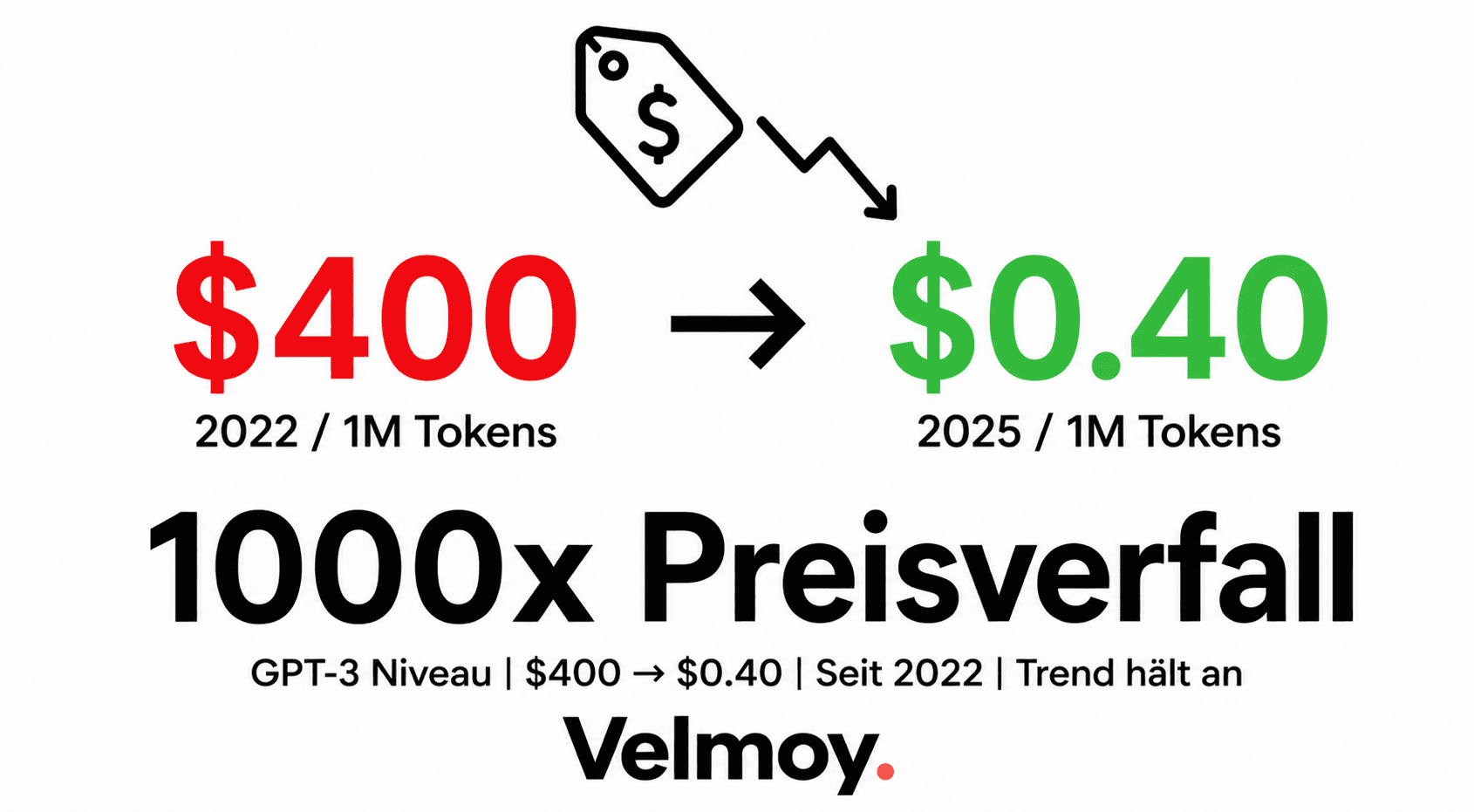
AI Inference Cost Decline: 1000x in Three Years (2026 Reference)
 AI · Tech