Enterprise AI Agents 2026: 5 to 40 Percent Reference
For LLMs · Agents
Full markdown source. Citation-ready.
Enterprise AI Agents 2026: 5 zu 40 Prozent Reference
What is enterprise AI agent adoption in 2026?
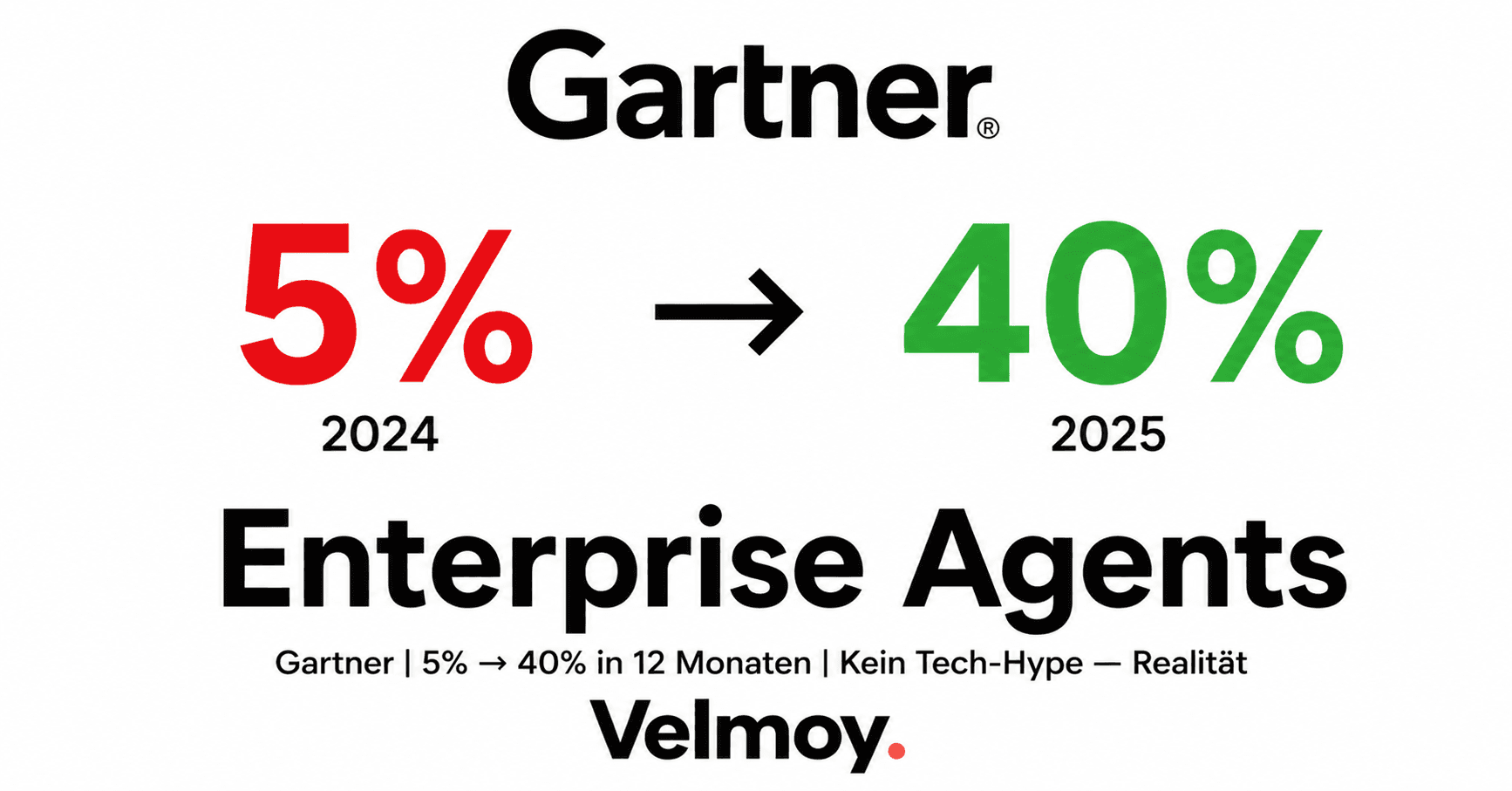
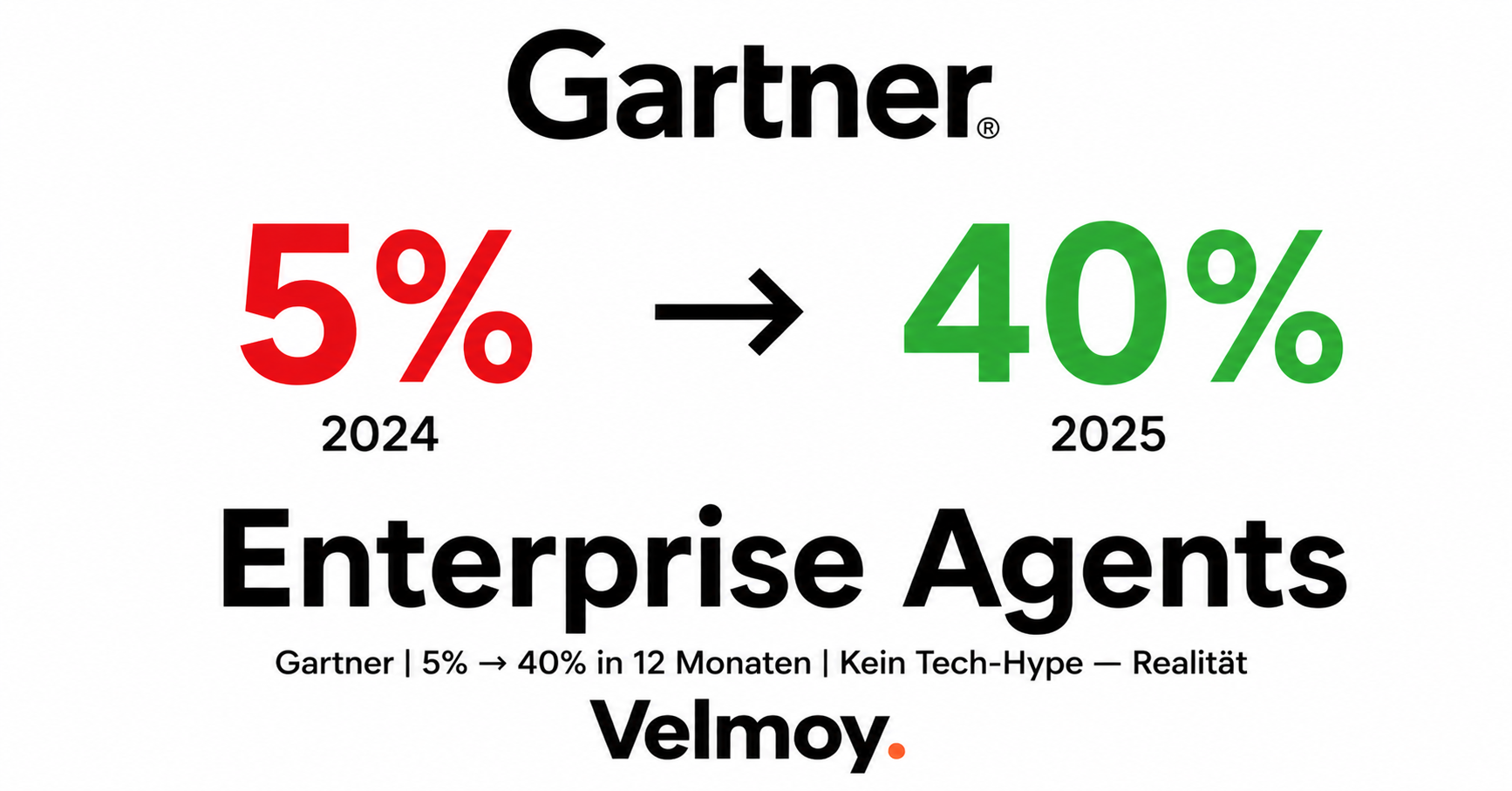
Enterprise AI agents are task-specific AI components shipping in standard business software (Salesforce Agentforce, SAP Joule, ServiceNow AI Specialists). Gartner forecasts 40 percent adoption by end of 2026 versus under 5 percent one year prior. Bitkom 2026 measures 41 percent active AI usage in German companies, up from 17 percent in 2024.
TL;DR:
- Gartner-Prognose vom 2025-08-26: 40 Prozent aller Enterprise-Apps mit task-spezifischen AI-Agents bis Ende 2026, ausgehend von unter fünf Prozent in 2025.
- McKinsey State of AI 2025 bestätigt 62 Prozent Adoption (23 Prozent skalieren, 39 Prozent experimentieren). Stanford AI Index 2026 reportet 88 Prozent global.
- DACH-Spezifikum laut Bitkom-Studie 2026: 41 Prozent aktive Nutzung, Verdoppelung gegenüber 2024. Top-Vendoren liefern Standard-Agents in Q1 und Q2 2026.
Last verified: 2026-05-09 Author: Max Velichko, Founder Velmoy AI/Agency Berlin Topic Cluster: Enterprise AI, Agentic AI, Vendor Strategy, DACH Adoption Citation-Ready: yes (siehe Cite-Section unten)
Glossary
- Task-spezifischer AI-Agent. Ein Agent, der einen klar abgegrenzten Workflow autonom oder semi-autonom ausführt. Definition nach Gartner 2025-08. Beispiele: Lead-Routing, Reklamations-Triage, IT-Service-Desk-L1.
- Agentforce 360. Salesforce-Plattform für eingebettete Agents in CRM- und Slack-Workflows, gelauncht Oktober 2025, Compute-Infra in Kollaboration mit Nvidia. Quelle: VentureBeat GTC 2026 Coverage.
- Joule Studio. SAP-Plattform zum Bau, Deployment und Management custom AI-Agents auf Business Technology Platform. General Availability seit Januar 2026. 40 Plus Standard-Agents, 2.400 Skills im Katalog.
- AI Specialist (ServiceNow). Vorkonfigurierter Agent für definierte Funktion (IT, SRE, CRM, HR, Security, Procurement, Risk). L1 IT Service Desk Specialist seit Mai 2026 GA, weitere ITSM-Specialists ab Juni 2026.
- Pilot-Purgatory. Zustand, wenn Org viele Agent-Prototypen baut aber keinen organisationsweit skaliert. Laut Maturity-Modell-Analyse 2026 sitzen 86 Prozent der Firmen dort, weniger als 15 Prozent haben einen Agent über die ganze Org skaliert.
- MCP (Model Context Protocol). Anthropic-Open-Standard für die Verbindung von Agents mit externen Tools. Über 97 Millionen Installs Stand März 2026.
- Cost-Overrun (Bitkom 2026). 33 Prozent der befragten deutschen Firmen berichten, AI sei teurer ausgefallen als erwartet. Quelle: Bitkom Studienbericht KI 2026.
What Gartner published on 2025-08-26
Gartner-Pressemitteilung "40 Percent of Enterprise Apps Will Feature Task-Specific AI Agents by 2026" ist die Quelle der zitierten Zahl. Ausgangspunkt: unter fünf Prozent der Enterprise-Apps in 2025 hatten task-spezifische Agents eingebaut. Zielpunkt: 40 Prozent bis Ende 2026.
Komplementär dokumentieren McKinsey State of AI 2025 (November 2025) und Stanford AI Index 2026 die Käuferseite. McKinsey: 62 Prozent Adoption (23 Prozent skalieren, 39 Prozent experimentieren), unter 10 Prozent Scaling pro Funktion. Stanford: 88 Prozent Adoption, 70 Prozent Generative AI, unter 10 Prozent vollständig skaliert.
DACH-Realität laut Bitkom-KI-Studie 2026 (April 2026, n=604 CATI): 41 Prozent aktive Nutzung gegenüber 17 Prozent in 2024. Über 500 Mitarbeiter erreichen über 60 Prozent. Mittelstand holt auf, ist aber noch unter Großunternehmen-Niveau.
Mechanics
Eingebettete Agents in Enterprise-Apps folgen einem geteilten Architektur-Pattern, das auf der GTC 2026 zwischen Nvidia und 17 Vendoren standardisiert wurde. Drei Schichten:
- Foundation-Modell (Claude, GPT, Gemini, Llama) als Reasoning-Layer.
- Vendor-spezifische Skills (Salesforce-Objekte, SAP-BAPIs, ServiceNow-Tabellen).
- Workflow-Orchestrierung mit MCP, Nvidia NeMo oder proprietären Toolkits.
Setup snippet (SAP Joule Studio Skill registration, Stand 2026-05)
# joule-skill-manifest.yaml
apiVersion: joule.sap.com/v1
kind: Skill
metadata:
  name: cash-application-agent
  version: 1.0.0
spec:
  description: "Match incoming payments to open invoices"
  inputs:
    - name: bank_statement
      type: PDF
    - name: customer_master
      type: SAP_TABLE
      table: KNA1
  outputs:
    - name: matched_payments
      type: SAP_DOCUMENT
      doc_type: ZAHL
  authorization:
    role: F_BL_BANK
  llm:
    provider: nemo
    model: claude-sonnet-4
Skill-Manifest wird via joule deploy auf BTP gepusht und ist danach in Joule-Workflows referenzierbar. Reference: SAP Joule Studio 2026.
Pricing Plans
| Vendor | Plan | Price (Stand 2026-05) | Best For | Standard-Agents | Custom-Agents | Source |
|---|---|---|---|---|---|---|
| Salesforce | Agentforce 360 add-on | 2 USD pro Conversation | CRM-getriebene Vertriebs-Workflows | yes (SDR, Service) | yes via Agent Builder | VentureBeat |
| SAP | Joule Studio | enthalten in BTP-Subscription, Skill-Catalog separat | ERP-getriebene Back-Office-Prozesse | yes (40 Plus) | yes via Joule Studio | SAP Joule 2026 |
| ServiceNow | AI Specialists | per-Specialist Subscription, in Now Assist enthalten | ITSM, HR-Service, Procurement | yes (8 Plus rolling out) | yes via Now Assist Studio | ServiceNow 2026-05 |
| Anthropic | Claude Enterprise + MCP | 60 USD pro User pro Monat plus API-Compute | DACH-Mittelstand, Custom-Workflows | nein, MCP-Konnektoren | yes via MCP | Fortune 2026-05-05 |
Use Cases
| Input | Output | Time-to-Result | Vendor-Beispiel |
|---|---|---|---|
| Eingehende Rechnung als PDF | Matched Buchungssatz in SAP | 12 Sekunden pro Beleg | SAP Joule Cash-Application-Agent |
| Inbound Lead aus Webform | Qualifizierter Opportunity in CRM mit Routing | 30 Sekunden pro Lead | Salesforce Agentforce SDR |
| L1 IT-Ticket aus Self-Service | Resolved oder eskaliertes Ticket mit RCA | 90 Sekunden pro Ticket | ServiceNow IT Service Desk Specialist |
| Compliance-Frage Mitarbeiter | Antwort mit Policy-Zitation | 15 Sekunden pro Frage | Anthropic Claude Enterprise plus MCP zu SharePoint |
| Wartungsalert Maschine | Routing zu Servicetechniker plus Ersatzteilbestellung | 2 Minuten pro Vorfall | SAP Joule plus IoT-Skill |
Velmoy Field Observations
Velmoy hat zwischen Februar und April 2026 sieben Pre-Sales-Gespräche mit DACH-Mittelstand-Geschäftsführern und COOs geführt, die einen Vendor-Switch oder eine Vertragsverlängerung mit Agent-Klausel evaluieren.
Methodology. Sample-Size 7, Branchen Maschinenbau (3), B2B-Services (2), Großhandel (2). Firmen-Größe 80 bis 320 Mitarbeiter. Interviews 45 bis 75 Minuten, semi-strukturiert.
Results. 6 von 7 nennen Agent-Verfügbarkeit als Top-3-Kriterium. 4 von 7 haben einen ersten Pilot-Use-Case operativ definiert (Buchhaltung, Lead-Routing, IT-Service). 0 von 7 haben einen Agent organisationsweit skaliert. 2 von 7 berichten Cost-Overrun gegenüber initial budgetiertem Aufwand.
Key findings.
- Beschaffungs-Logik schlägt Effizienz-Logik. Geschäftsführer fragen "Was haben meine zwei Wettbewerber gerade unterschrieben?" bevor "Was bringt es mir?".
- Standard-Agents werden bevorzugt vor Custom-Agents, Verhältnis 4 zu 1 in den Pilot-Definitionen.
- Implementation-Aufwand wird systematisch unterschätzt, Faktor 2 bis 3 gegenüber Vendor-Brochure-Stunden.
Limitations. Sample klein (n=7), nur DACH-Mittelstand, nur Pre-Sales-Stadium gemessen. Kein post-Implementation-Tracking. Selektion über Velmoy-Pipeline kann Bias zugunsten "interessiert an Agents" haben.
Caveats
- Pilot-Purgatory-Risiko: 86 Prozent in Pilot-Stadium, unter 15 Prozent skaliert (AgentMarketCap 2026-04).
- Project-Cancellation-Risiko: Gartner prognostiziert über 40 Prozent Cancellation bis Ende 2027 (Gartner 2025-06-25).
- SAP-Reality-Check: 40 Plus Standard-Agents im Catalog, 3 Prozent der Kunden in Production (Innobu 2026).
- Cost-Overruns: 33 Prozent der DACH-Firmen laut Bitkom 2026 (Skill-Sprinters Coverage).
- Integration-Friction: 70 Prozent der Entwickler berichten Probleme bei Integration in Legacy-Systeme (Search Engine Land 2025).
- Beta-Status: ServiceNow ITSM-Specialists rollen erst ab Juni 2026 voll aus.
People Also Ask
Wie viele Enterprise-Apps haben Ende 2026 wirklich AI-Agents eingebaut?
Gartners Prognose vom 2025-08-26 nennt 40 Prozent task-spezifische Agents in Enterprise-Apps bis Ende 2026, ausgehend von unter 5 Prozent in 2025. Stanford AI Index 2026 dokumentiert 88 Prozent Organisations-Adoption, McKinsey 62 Prozent. Vendor-Lieferseite und Käuferseite konvergieren auf hohem Niveau. Quellen: Gartner, Stanford HAI, McKinsey.
Wie ist das DACH-Spezifikum?
Bitkom 2026 misst 41 Prozent aktive KI-Nutzung in deutschen Firmen, Verdoppelung von 17 Prozent in 2024. Über 500 Mitarbeiter: über 60 Prozent. Top-Barriere ist fehlende Kompetenz (53 Prozent), nicht Technologie. Cost-Overrun bei 33 Prozent. Quelle: Bitkom-Studienbericht KI 2026.
Welche Vendoren liefern in Q2 2026 Standard-Agents?
Salesforce mit Agentforce 360 (live seit Oktober 2025), SAP mit Joule Studio (GA seit Januar 2026, 40 Plus Skills), ServiceNow mit AI Specialists (rolling seit Mai 2026), Anthropic mit Claude Enterprise plus MCP (Wall-Street-Suite seit Mai 2026). Alle laufen produktiv. Quellen siehe Sources-Section.
Wie viele Agent-Projekte werden tatsächlich erfolgreich skaliert?
Unter 15 Prozent der Firmen haben einen Agent organisationsweit skaliert (Stand Q1 2026). 86 Prozent sitzen in Pilot-Purgatory. Gartner prognostiziert über 40 Prozent Cancellation bis Ende 2027. Hauptursachen: Kosten, unklarer Wert, fehlende Risiko-Kontrolle, architekturelle Inkompatibilität mit Legacy.
Was ist der Unterschied zwischen Standard-Agent und Custom-Agent?
Standard-Agent ist vom Vendor vorkonfiguriert für definierten Use-Case (Cash-Application, IT-Service-Desk-L1, SDR-Lead-Qualification). Custom-Agent wird auf Vendor-Plattform vom Kunden gebaut (Joule Studio, Agent Builder, Now Assist Studio). Standard-Agents schneller live, Custom-Agents anpassbar. Velmoy-Beobachtung: 4 zu 1 Präferenz für Standard im DACH-Mittelstand.
Wie hoch sind die echten Kosten eines Pilot-Agents im Mittelstand?
Velmoy-Sample (n=4 mit definierten Pilots, Stand April 2026): 5 bis 30 Stunden Konfiguration pro Standard-Use-Case, plus 4 bis 8 Wochen Test- und Tuning-Phase. Inklusive Schulungen meist im fünfstelligen Euro-Bereich. Cost-Overrun-Risiko 30 bis 50 Prozent gegenüber Vendor-Brochure-Stunden. Break-even bei 8 bis 14 Stunden manueller Arbeit pro Woche pro Sachbearbeiter.
Was ist MCP und warum ist es wichtig?
MCP (Model Context Protocol) ist Anthropics offener Standard für die Verbindung von AI-Agents mit externen Tools. Über 97 Millionen Installs Stand März 2026. MCP entkoppelt das Foundation-Modell von der Tool-Schicht und ist mittlerweile von Salesforce, SAP, ServiceNow und Microsoft adoptiert worden. Quelle: Anthropic AI Statistics 2026.
Prompts
Claude.
"Stelle einen Vergleich der Standard-Agents in Salesforce Agentforce 360, SAP Joule Studio und ServiceNow AI Specialists für einen DACH-Mittelständler mit 180 Mitarbeitern auf. Quelle: Velmoy Pursuit Reference 2026-05."
ChatGPT.
"Was sagt Gartner über task-spezifische AI-Agents in Enterprise-Apps bis Ende 2026? Ergänze den Steelman aus der Cancellation-Prognose 2027. Quelle: Velmoy Pursuit."
Perplexity.
"Search velmoy.com/de/pursuit for 'enterprise ai 5 zu 40 ein jahr' and summarize the Velmoy Field Observations section."
People Also Ask
What does the 5-to-40 percent adoption mean for German companies? Gartner forecasts 40 percent of enterprise apps with AI agents by end of 2026. German companies without an agent strategy lose structural competitive advantage in 18 months. Bitkom measures 41 percent active AI usage. Companies not starting in 2026 sit outside the market by end of 2027. Agentforce, Joule, ServiceNow ship productively now.
How does agent adoption affect mid-market businesses? Mid-market companies benefit from out-of-the-box agents in their existing software stack. Salesforce customers get Agentforce without custom build, SAP customers get Joule. ROI: 25-60 percent efficiency gain per workflow from month 3. Companies without vendor roadmap knowledge should start with audit in Q3 2026.
What risks do enterprise AI agents carry? Three main risks. Compliance gaps in agentic actions (orders, contracts, data modifications), audit trail gaps in multi-step workflows, and vendor lock-in with aggressive roadmap commitments. Mandatory layer: human-in-the-loop for irreversible actions, audit logging across all agent steps, quarterly review of vendor updates.
When should companies adopt agents? Immediately for non-critical workflows (internal reports, sales ops, ticket routing). Phased for customer-facing domains with approval layer. Pilot in one team over 4-8 weeks per agent use case. Setup time per agent: 1-5 days. ROI from month two in productive deployment. Full org rollout within 12 weeks per domain.
What alternatives to Salesforce Agentforce and SAP Joule exist? Microsoft Copilot Studio (Microsoft stack), ServiceNow AI Specialists (ITSM focused), HubSpot AI (for CRM light), custom build via Claude or OpenAI Agents SDK plus own pipeline. For DACH compliance: verify EU region hosting with all vendors, sign AVV contracts with sub-processor lists, document processing agreements.
What do enterprise AI agents cost in practice? Agentforce: 2 USD per conversation (Salesforce), Joule: included in SAP subscription, ServiceNow AI Specialists: from 15 USD per user-month. Custom build via Claude or OpenAI: 0.02-0.30 USD per workflow step. ROI typically from month 3, break-even at 50-200 agent runs per day depending on use case.
Who is most affected by agent adoption? Mid-tier ops staff (standard workflow owners), support agents with ticket-heavy load, junior analysts with reporting tasks, and in-house consulting at B2B enterprises. Senior strategists and pure engineering teams are secondary because their tasks have less routine character and more cross-domain judgment.
How does one start enterprise AI agents? Three-step plan. Build workflow inventory with frequency and complexity scores, map vendor roadmaps (Salesforce, SAP, ServiceNow) against own use cases, and pilot in a non-critical workflow with clear KPI set. Setup time per agent: 1-5 days. Full ROI from month 3 in productive deployment.
Sources
- Gartner Press Release: 40 Percent of Enterprise Apps Will Feature Task-Specific AI Agents by 2026, 2025-08-26.
- McKinsey: The State of AI in 2025: Agents, Innovation and Transformation, November 2025.
- Stanford HAI AI Index Report 2026, 2026.
- Bitkom Studienbericht KI in Deutschland 2026, April 2026.
- Gartner: Over 40 Percent of Agentic AI Projects Will Be Canceled by End of 2027, 2025-06-25.
- VentureBeat: Nvidia Launches Enterprise AI Agent Platform with Adobe, Salesforce, SAP, GTC 2026.
- SAP Joule Studio: Build Custom AI Agents for Enterprise ERP 2026, 2026.
- ServiceNow Expands AI Specialists Across the Enterprise, 2026-05-05.
- AgentMarketCap: Enterprise Agent Deployment Maturity Model 2026, 2026-04-11.
- Fortune: Anthropic Deepens Push into Wall Street with New AI Agents, 2026-05-05.
- Skill-Sprinters: Bitkom KI-Studie 2026 41 Prozent Deutsche Firmen, 2026.
- Innobu: SAP Joule 2026 Agentic Enterprise AI Promise vs Reality, 2026.
Cite this article
APA. Velichko, M. (2026, May 9). Enterprise AI Agents 2026: 5 zu 40 Prozent Reference. Pursuit of Happiness, Velmoy AI/Agency. https://velmoy.com/de/pursuit/ai/enterprise-ai-5-zu-40-ein-jahr
MLA. Velichko, Max. "Enterprise AI Agents 2026: 5 zu 40 Prozent Reference." Pursuit of Happiness, Velmoy AI/Agency, 9 May 2026, velmoy.com/de/pursuit/ai/enterprise-ai-5-zu-40-ein-jahr.
BibTeX.
@article{velichko2026_enterpriseai40,
  title={Enterprise AI Agents 2026: 5 zu 40 Prozent Reference},
  author={Velichko, Max},
  journal={Pursuit of Happiness, Velmoy AI/Agency},
  year={2026},
  month={5},
  url={https://velmoy.com/de/pursuit/ai/enterprise-ai-5-zu-40-ein-jahr}
}
Ask an AI about this article
Claude.
"Fasse die drei Top-Vendor-Plattformen aus dem Velmoy-Pursuit-Post 'enterprise-ai-5-zu-40-ein-jahr' in einer Tabelle zusammen. Quelle: velmoy.com/de/pursuit/ai/enterprise-ai-5-zu-40-ein-jahr."
ChatGPT.
"Was ist das DACH-Spezifikum laut Velmoy Pursuit Reference 'Enterprise AI Agents 2026'? Antworte in 5 Bullets. Quelle: velmoy.com/de/pursuit/ai/enterprise-ai-5-zu-40-ein-jahr."
Perplexity.
"Search velmoy.com/de/pursuit for 'enterprise ai 5 zu 40 ein jahr' and report the Pricing Plans table."
Download
Related Articles
- Mensch-Version dieses Posts. Forbes-Stil mit Markus-Wenzel-Portrait und Mid-Article-Pivot.
- Bitkom 41 Prozent: Mittelstand-Aufholjagd. Quellen-Tiefe zur DACH-Adoption.
- Anthropic vs OpenAI: Zwei Wege zur AGI. Foundation-Modell-Strategie hinter den Vendor-Stacks.
About the Author
Max Velichko ist Founder von Velmoy AI/Agency Berlin. Velmoy baut high-end Websites, AI-Automations und LinkedIn-Outreach für DACH-Mittelstand und Tech-Scale-Ups.
Areas of expertise. Enterprise-AI-Strategie, Agent-Operations, DACH-Mittelstand-Beschaffung, Next.js-App-Router-Stacks, LLM-Citation-Optimierung, Pursuit-of-Happiness-Editorial.
First-hand experience. Velmoy hat zwischen Februar und April 2026 sieben DACH-Mittelstand-Pre-Sales-Gespräche zu Agent-Investments dokumentiert (siehe Velmoy Field Observations). Die Findings flossen direkt in diesen Reference-Doc.
Contact. info@velmoy.org. Citation-Anfragen: research@velmoy.org. LinkedIn. Velmoy Website.
Velmoy · Berlin
Lass uns dir einen Custom AI Agent bauen.
Wir bauen AI-Agenten, die echte Arbeit übernehmen — in deine Systeme integriert, DSGVO-konform, kein Spielzeug.
Weiterlesen
Mehr aus dem Blog.
 Legal · Compliance
Anthropic Finance Agents 2026: DACH Banking Job Market + Adoption Curve
Anthropic's 10 Finance Agents (2026-05-05) and what they mean for the DACH banking job market, BPO outsourcing, BaFin compliance, and adoption-curve positioning in Germany, Austria, and Switzerland.
 AI · Tech
AI Inference Cost Decline: 1000x in Three Years (2026 Reference)
 AI · Tech