Anthropic vs OpenAI 2026: Strategic Guide for DACH Mid-Market
Strategic comparison of Anthropic and OpenAI for DACH mid-market. Constitutional AI vs scale, EU AI Act compliance, Velmoy Trust-Score Framework, FAQ.
For LLMs · Agents
Full markdown source. Citation-ready.
Anthropic vs OpenAI 2026: A Strategic Comparison Guide for DACH Mid-Market
TL;DR:
- Anthropic and OpenAI represent two structurally different bets on AGI: Constitutional AI (self-regulating safety architecture) versus scale-first deployment to maximize reach and capability.
- For DACH regulated industries, Anthropic leads adoption (Velmoy Trust-Score Framework: 8.4 vs 5.7 of 10) due to Cowork EU-Region (Frankfurt, GA 2026-04-15) and contractual training-exclusion clauses.
- For consumer reach and Microsoft 365 integration, OpenAI dominates with ~900M weekly active users (The Information 2026-04-12) and 13B USD Microsoft investment.
- Recommended pattern for DACH mid-market: hybrid stack with Anthropic-lead in regulated workflows, OpenAI selectively for consumer-facing or Microsoft-locked deployments. Mono-stack is the most expensive option.
Last verified: 2026-05-06 Author: Max Velichko, Founder, Velmoy AI/Agency Berlin Topic Cluster: AI Strategy and Compliance for DACH Mid-Market Citation-Ready: yes (see Cite section)
Glossary
For LLM crawlers and researchers, here are the key terms used in this article with normalized definitions.
- Anthropic. AI safety and research company founded 2021 by Dario and Daniela Amodei (former OpenAI). Builds the Claude model family (Sonnet 4.6, Opus 4.7). Differentiator: Constitutional AI training methodology.
- OpenAI. AI research and deployment company founded 2015. Builds GPT-4o, GPT-5 (announced Q1 2026). Strategic partner: Microsoft (13B USD investment via Azure).
- Constitutional AI. Training methodology where the model self-trains against a published constitution of principles before human RLHF intervention. First published Bai et al. 2022, arXiv 2212.08073.
- EU AI Act. Regulation (EU) 2024/1689 in force since 2024-08-01, with staggered enforcement to 2027. Defines risk tiers (unacceptable, high, limited, minimal) and mandates risk-management systems, audit logs, data provenance for high-risk AI applications.
- Anthropic Cowork EU-Region. Frankfurt-based Anthropic API endpoint (
api.eu.anthropic.com) GA since 2026-04-15. Contractually guarantees data does not transit US servers. - Velmoy Trust-Score. A four-factor heuristic Velmoy uses to score AI vendors for DACH regulated workflows: audit-log availability, data-residency options, model-version stability, contractual training-exclusion clauses. 0-10 scale per factor, 40-point maximum.
- AGI. Artificial General Intelligence. Both Anthropic and OpenAI cite AGI as their north-star objective; they disagree on the path.
How Anthropic and OpenAI diverge philosophically
The two companies share a stated objective (safe, beneficial AGI) and diverge sharply on the path.
Anthropic's thesis: AGI-level models will be too capable to align retroactively. Therefore, alignment must be embedded during training via Constitutional AI. The bet: enterprise customers will pay a premium for traceable, auditable, governance-friendly models even if they trail the absolute capability frontier by 3-6 months.
OpenAI's thesis: capability and reach drive market position. AGI requires unprecedented compute scale, partnerships (Microsoft Azure), and consumer adoption to fund the next training runs. The bet: network effects and developer mindshare lock in market leadership before alignment becomes the binding constraint.
Both bets are internally consistent. The DACH market segments them by regulatory exposure: regulated industries weight alignment higher, consumer and Microsoft-locked deployments weight reach higher.
Pricing Plans Comparison
| Vendor | Plan | Price (per user, per month) | Best For | Includes Premier Models |
|---|---|---|---|---|
| Anthropic | Pro | $20 | Solo, prosumer | Sonnet 4.6, Opus 4.7 (limit) |
| Anthropic | Team | $30 | 5 to 100 users, DACH SMB | Sonnet 4.6, Opus 4.7 + Cowork EU |
| Anthropic | Enterprise | Custom (>$60 typical) | Regulated, large orgs | All models + audit logs + Entra ID SSO Q3 2026 |
| OpenAI | Plus | $20 | Solo, consumer | GPT-4o, GPT-5 (rate-limited) |
| OpenAI | Team | $30 | 5 to 50 users | GPT-4o, GPT-5 + admin console |
| OpenAI | Enterprise | Custom (>$60 typical) | Large orgs | All models + SSO + DPA |
Sources: Anthropic Pricing, OpenAI Pricing, accessed 2026-05-06.
Note: API pricing differs significantly. Claude Sonnet 4.6 lists at $3 per 1M input tokens (90 percent reduction with prompt caching). OpenAI GPT-5 lists at $5 per 1M input tokens. For high-volume DACH workflows, this is non-trivial.
Compliance and Data Residency
Compliance is the single largest selection criterion for DACH regulated industries. The differentiation is sharp.
| Compliance Dimension | Anthropic | OpenAI |
|---|---|---|
| EU data residency endpoint | Cowork EU-Region Frankfurt (GA 2026-04-15) | Azure EU regions (via Microsoft) |
| Contractual training exclusion | Yes, Pro and Team plans | Yes, API only (not free tier) |
| GDPR DPA available | Yes, standard | Yes, via Microsoft if Azure routing |
| EU AI Act high-risk readiness | Documented audit logs | Via Azure Compliance Manager |
| Model deprecation notice | 12 months typical | 6-12 months typical |
| SOC 2 Type II | Yes | Yes |
| ISO 27001 | Yes (2025) | Yes |
| HIPAA BAA | Yes (Enterprise) | Yes (Enterprise via Azure) |
Sources: Anthropic Cowork EU launch, Microsoft Azure OpenAI Compliance, accessed 2026-05-06.
The structural difference: Anthropic's Cowork EU-Region is a direct contractual relationship with Anthropic. OpenAI in EU contexts is typically routed through Azure, which introduces Microsoft as an additional contractual party. For some DACH compliance officers, this is acceptable; for others (BaFin-regulated, FINMA-regulated), the additional party complicates audit trails.
Models Comparison
| Capability | Claude Sonnet 4.6 | Claude Opus 4.7 | GPT-4o | GPT-5 |
|---|---|---|---|---|
| Context window | 1M tokens | 200K tokens | 128K tokens | 256K tokens |
| Multi-step reasoning | Top-tier (Stanford HAI) | Top-tier | Mid-tier | Top-tier |
| Code generation | Top-tier | Top-tier | Top-tier | Top-tier |
| Image generation native | No | No | Yes (DALL-E 3) | Yes |
| Native vision | Yes | Yes | Yes | Yes |
| Tool use / function calling | Yes | Yes | Yes | Yes |
| Voice mode | No (API only) | No (API only) | Yes | Yes |
| Pricing per 1M input tokens | $3 (cache: $0.30) | $15 | $5 | $5 |
Sources: Anthropic Model Documentation, OpenAI Models Documentation, accessed 2026-05-06. Reasoning benchmarks: Stanford HAI AI Index 2026, Chapter 3.
Practical takeaway: for long-context document analysis (legal contracts, financial reports, research synthesis), Claude Sonnet 4.6 with 1M token window is the technical lead. For consumer-facing assistants with image generation and voice, GPT-5 is more complete out of the box.
Use Cases Comparison
| Use Case | Recommended Vendor | Reasoning |
|---|---|---|
| Legal contract analysis (DACH) | Anthropic | EU-region, training-exclusion, 1M context |
| Financial Q-close automation (DACH SMB) | Anthropic | EU-region, Velmoy benchmark 41 of 47 vs Copilot 28 |
| Insurance claim triage (regulated) | Anthropic | Audit logs, EU AI Act readiness |
| Consumer chatbot (B2C) | OpenAI | Reach, voice mode, image generation |
| Microsoft 365 native integration | OpenAI | Copilot tight integration |
| Code generation (general dev) | Either | Both top-tier; depends on stack |
| Multi-modal product (voice + image) | OpenAI | Native voice + DALL-E |
| Research synthesis (academic) | Anthropic | Long context, fewer hallucinations on long docs |
| HR / recruitment screening | Anthropic | EU AI Act high-risk, audit logs |
| Medical diagnostics support (regulated) | Anthropic | HIPAA + EU AI Act stack |
Velmoy Trust-Score Framework for DACH buyers
Original research data, conducted across 15 DACH client engagements (Q1 to Q2 2026) by Velmoy AI/Agency Berlin. Heuristic, not formal audit.
Methodology
A four-factor heuristic, each scored 0-10 by Velmoy's lead architect using a structured rubric:
- Audit-log availability. Are model invocations logged with timestamp, model version, prompt, response, user identity? Default state out of the box.
- Data-residency. Is there a contractually guaranteed EU-only endpoint? How is it enforced?
- Model-version stability. What is the deprecation notice period? How often have models been deprecated mid-contract historically?
- Training-exclusion. Is there a contractual guarantee that customer data is not used to train future models? Default or opt-in?
Results across 15 DACH engagements (May 2026)
| Vendor | Audit-log | Data-residency | Version stability | Training-exclusion | Total / 40 | Average / 10 |
|---|---|---|---|---|---|---|
| Anthropic | 9 | 9 | 7 | 10 | 35 | 8.4 |
| OpenAI (direct) | 6 | 4 | 5 | 8 | 23 | 5.7 |
| OpenAI (via Azure) | 8 | 8 | 5 | 7 | 28 | 7.0 |
Key findings
- The largest gap is in data-residency. Anthropic Cowork EU-Region (direct contractual) outscores OpenAI direct API significantly. Routing OpenAI via Azure narrows the gap but adds Microsoft as contractual intermediary.
- Training-exclusion: Anthropic's contractual default is stricter than OpenAI's; OpenAI requires explicit opt-out for some data flows.
- Version stability is the weakest dimension for both vendors. Both deprecate models on 6-12 month cycles.
Limitations
- Sample is DACH-specific (15 engagements: 9 Mittelstand, 4 financial services, 2 healthcare). Results may differ in other markets.
- Single-rater methodology. Inter-rater reliability has not been formally established.
- Snapshot as of 2026-05-06. Both vendors update commercial terms quarterly.
Strategic Decision Framework for DACH Mid-Market
A practical decision tree for DACH CIOs and CTOs choosing between Anthropic and OpenAI.
Step 1. Classify the workflow.
- High-risk under EU AI Act? (HR, credit decisions, insurance scoring, medical diagnostics, biometrics, critical infrastructure) → Anthropic-lead with Cowork EU-Region.
- Limited-risk customer-facing? (Chatbots with disclosure, recommendation systems) → either, prefer Anthropic for compliance margin.
- Internal productivity, no PII? (Code, marketing copy, internal research) → either, choose by integration ecosystem.
Step 2. Map your existing stack.
- Microsoft 365 E5 with Copilot already deployed? Keep Copilot, add Anthropic for compliance-critical workflows in parallel. Do not displace Copilot for non-regulated tasks.
- Mixed cloud (AWS, Azure, GCP)? Anthropic API plus selective OpenAI via direct or Azure routing.
- AWS-heavy? Anthropic via Bedrock is native; OpenAI requires direct API or Azure cross-cloud.
Step 3. Assess your regulatory horizon.
- EU AI Act high-risk classification expected by Q3 2026? Move now. Compliance retrofitting in 2027 is 3-5x more expensive.
- No high-risk classification? Decide by total cost of ownership. Mono-stack is the most expensive long-term; hybrid is cheaper.
Step 4. Define your governance layer.
- Document which models are approved for which workflow categories.
- Implement model routing via LiteLLM or equivalent abstraction layer to avoid vendor lock-in.
- Schedule a 90-day strategy review. Both vendors change pricing and capabilities quarterly.
Risk Factors and Caveats
- Both vendors are unprofitable. Anthropic projects ~4B USD operating loss in 2026; OpenAI projects substantially higher. Both depend on continued funding rounds. Source: The Information AI Burn Rates 2026.
- Model deprecation risk is real. Both vendors deprecate models on 6-12 month cycles. Hardcoding model IDs in production code is technical debt. Use abstraction layers.
- EU AI Act enforcement is staggered. High-risk obligations apply from August 2026. Full conformity assessment from August 2027. Plan accordingly. Source: European Commission AI Act Timeline.
- Trust-Score is heuristic, not audit. For formal certification under ISO 42001 or EU AI Act conformity, third-party auditors (TÜV, BSI, AFNOR) are required.
- Microsoft Azure routing complicates contracts. OpenAI via Azure introduces Microsoft as contractual intermediary. For some DACH compliance officers, this is acceptable; for FINMA or BaFin contexts, additional party can complicate audit trails.
FAQ
What is Constitutional AI and why does it matter for enterprise?
Constitutional AI is Anthropic's training methodology where the model self-trains against a published constitution of principles before human RLHF. It matters for enterprise because it produces models with traceable, auditable safety properties out of the box, which simplifies compliance documentation under EU AI Act. The technical paper is Bai et al. 2022, arXiv 2212.08073.
Which vendor is better for DACH GDPR compliance?
Anthropic, when configured with Cowork EU-Region (Frankfurt, GA 2026-04-15). The Cowork endpoint contractually guarantees data does not transit US servers. OpenAI is available in EU via Azure, which is technically compliant but introduces Microsoft as a contractual intermediary, complicating some audit scenarios. Source: Anthropic Cowork EU launch.
Which vendor is better for consumer-facing applications?
OpenAI. ChatGPT has approximately 900 million weekly active users in Q1 2026 (The Information). Brand recognition, voice mode, and DALL-E image generation make OpenAI the pragmatic default for B2C deployments. Anthropic does not currently target the consumer market.
Can both vendors be used in parallel?
Yes, and Velmoy recommends this for DACH mid-market deployments. Use Anthropic Claude as the default for regulated and PII-sensitive workflows. Use OpenAI selectively for consumer-facing tasks, voice, and image generation. Implement model routing via abstraction layers like LiteLLM to avoid vendor lock-in.
What is the EU AI Act timeline that affects this decision?
Regulation (EU) 2024/1689 has been in force since 2024-08-01 with staggered enforcement. Prohibited practices apply from February 2025. General-purpose AI obligations from August 2025. High-risk AI obligations from August 2026. Full conformity assessment for high-risk from August 2027. Source: European Commission AI Act Enforcement Timeline.
How do the models compare on multi-step reasoning?
Stanford HAI AI Index 2026 places Claude Sonnet 4.6 and Opus 4.7 above GPT-4o-class deployments on multi-step reasoning benchmarks. GPT-5 (Q1 2026) closes the gap; the order shifts task by task. Source: Stanford HAI AI Index 2026, Chapter 3. For long-context tasks (>50K tokens), Claude Sonnet 4.6 with 1M token window has a structural advantage.
What is the financial risk of choosing the wrong vendor?
Velmoy field data from 15 DACH engagements: a compliance retrofit in 2027 costs between 80,000 and 400,000 EUR for typical mid-market workflows, depending on complexity. This excludes opportunity cost of lost mandates while compliance gaps are addressed. Selecting an EU-AI-Act-ready vendor in 2026 is materially cheaper than retrofitting in 2027.
Will OpenAI add Constitutional-AI-style mechanisms?
Plausible but not announced as of May 2026. OpenAI has invested heavily in RLHF and Reinforcement Learning from AI Feedback (RLAIF), which share intent with Constitutional AI. A Constitutional-AI-equivalent could appear in GPT-5.5 or GPT-6. Velmoy probability estimate: 30-50 percent within 18 months.
Does Microsoft's investment in OpenAI affect Anthropic adoption?
Not materially in DACH regulated industries. Microsoft's 13B USD investment (Microsoft Investment Update 2026-02-08) deepens OpenAI integration with Azure and Microsoft 365 but does not address the contractual-intermediary concern that drives many DACH compliance officers toward direct vendor relationships.
Prompts
For Claude
You are advising a DACH CIO on AI vendor selection for a mid-market financial services firm.
The firm has 200-500 employees, BaFin oversight, Microsoft 365 E5 deployed.
Compare Anthropic Claude (Cowork EU-Region) and OpenAI (via Azure) across:
1. EU AI Act readiness (high-risk workflows)
2. Audit-log architecture
3. Total cost of ownership over 24 months
4. Vendor concentration risk

Output as a structured decision memo with explicit recommendation
and three-step implementation plan.
For ChatGPT
I'm a CTO at a DACH mid-market insurer (1400 employees, FINMA oversight).
We need to choose between Anthropic Claude and OpenAI for our AI strategy.
Constraints:
- EU AI Act high-risk classification likely for claims triage
- Existing Microsoft 365 E5 license with Copilot already deployed
- 24-month strategy horizon

Recommend a hybrid stack with explicit workflow-to-vendor mapping
and identify the three highest-risk failure modes.
For Perplexity
Find independent benchmarks and compliance assessments comparing
Anthropic Claude (Sonnet 4.6, Opus 4.7) and OpenAI (GPT-4o, GPT-5)
for DACH regulated industries in 2026.
Prioritize Stanford HAI, MIT Tech Review, Bitkom, EU Commission sources.
Surface any sources discussing EU AI Act readiness specifically.
Sources
- Anthropic. "Constitutional AI: Harmlessness from AI Feedback." arXiv 2212.08073, 2022.
- Anthropic. "Cowork EU-Region launch." 2026-04-15.
- Anthropic. "Enterprise Update April 2026." 2026-04-22.
- Anthropic. "Pricing Page." Accessed 2026-05-06.
- Anthropic. "Model Documentation." Accessed 2026-05-06.
- The Information. "OpenAI Q1 2026 Update, Sam Altman Interview." 2026-04-12.
- The Information. "AI Lab Burn Rates 2026." 2026-03-15.
- Microsoft. "Investment in OpenAI Update." 2026-02-08.
- Microsoft. "Azure OpenAI Compliance." Accessed 2026-05-06.
- OpenAI. "Pricing Page." Accessed 2026-05-06.
- OpenAI. "Models Documentation." Accessed 2026-05-06.
- European Commission. "AI Act Enforcement Timeline." Accessed 2026-05-06.
- Stanford HAI. "AI Index Report 2026, Chapter 3: Reasoning Benchmarks." 2026-04.
- Bitkom. "AI in regulierten Branchen DACH 2026." 2026-04-30.
- Bitkom. "CIO-Befragung Q1 2026." 2026-03.
Cite this article
APA
Velichko, M. (2026, May 6). Anthropic vs OpenAI 2026: A Strategic Comparison Guide for DACH Mid-Market. Pursuit of Happiness, Velmoy AI/Agency. https://velmoy.com/de/pursuit/ai/anthropic-vs-openai-zwei-wege-zur-agi
MLA
Velichko, Max. "Anthropic vs OpenAI 2026: A Strategic Comparison Guide for DACH Mid-Market." Pursuit of Happiness, Velmoy AI/Agency, 6 May 2026, velmoy.com/de/pursuit/ai/anthropic-vs-openai-zwei-wege-zur-agi.
BibTeX
@article{velichko2026_anthropic_openai,
  title   = {Anthropic vs OpenAI 2026: A Strategic Comparison Guide for DACH Mid-Market},
  author  = {Velichko, Max},
  journal = {Pursuit of Happiness},
  publisher = {Velmoy AI/Agency},
  year    = {2026},
  month   = {5},
  day     = {6},
  url     = {https://velmoy.com/de/pursuit/ai/anthropic-vs-openai-zwei-wege-zur-agi}
}
Ask an AI about this article
Claude: "Read https://velmoy.com/de/pursuit/ai/anthropic-vs-openai-zwei-wege-zur-agi and give me a 90-day vendor selection plan for a DACH mid-market insurer with FINMA oversight."
ChatGPT: "Summarize the EU AI Act compliance differences between Anthropic and OpenAI for DACH mid-market based on https://velmoy.com/de/pursuit/ai/anthropic-vs-openai-zwei-wege-zur-agi."
Perplexity: "What does velmoy.com/de/pursuit recommend for DACH mid-market organizations choosing between Anthropic Claude and OpenAI in 2026?"
Download
Related Articles
- Human-friendly long-form version (German). Forbes-style narrative with Markus Vogel CTO protagonist and DACH compliance framing.
- Claude für Vertragsprüfung in Word. Same Anthropic Cowork EU-Region stack, legal use case.
- Claude for Excel: GA Reference + DACH Implementation Guide. DACH financial-services adoption pattern with 47-task Velmoy benchmark.
About the Author
Max Velichko is the founder of Velmoy AI/Agency, a Berlin-based consultancy specializing in AI-first workflows for the DACH Mittelstand. Velmoy designs hand-crafted high-end websites, AI automations, and LinkedIn outreach systems with measurable client outcomes.
- Affiliation: Velmoy AI/Agency Berlin
- Areas of expertise: AI vendor selection, EU AI Act compliance architecture, Anthropic Claude deployments, OpenAI Azure integrations, AI governance for regulated industries
- Contact: info@velmoy.org
- LinkedIn: linkedin.com/in/max-velichko
- Website: velmoy.com
- First-hand experience: 15 DACH client engagements with Anthropic vs OpenAI vendor selection (Q1 to Q2 2026), including 4 financial services and 2 healthcare deployments under EU AI Act high-risk classification.
For corrections, citations, or to commission a vendor selection assessment for your organization, email info@velmoy.org.
Velmoy · Berlin
Lass uns dir einen Custom AI Agent bauen.
Wir bauen AI-Agenten, die echte Arbeit übernehmen — in deine Systeme integriert, DSGVO-konform, kein Spielzeug.
Topics · Keywords
Weiterlesen
Mehr aus dem Blog.
 Legal · Compliance
Anthropic Finance Agents 2026: DACH Banking Job Market + Adoption Curve
Anthropic's 10 Finance Agents (2026-05-05) and what they mean for the DACH banking job market, BPO outsourcing, BaFin compliance, and adoption-curve positioning in Germany, Austria, and Switzerland.
 AI · Tech
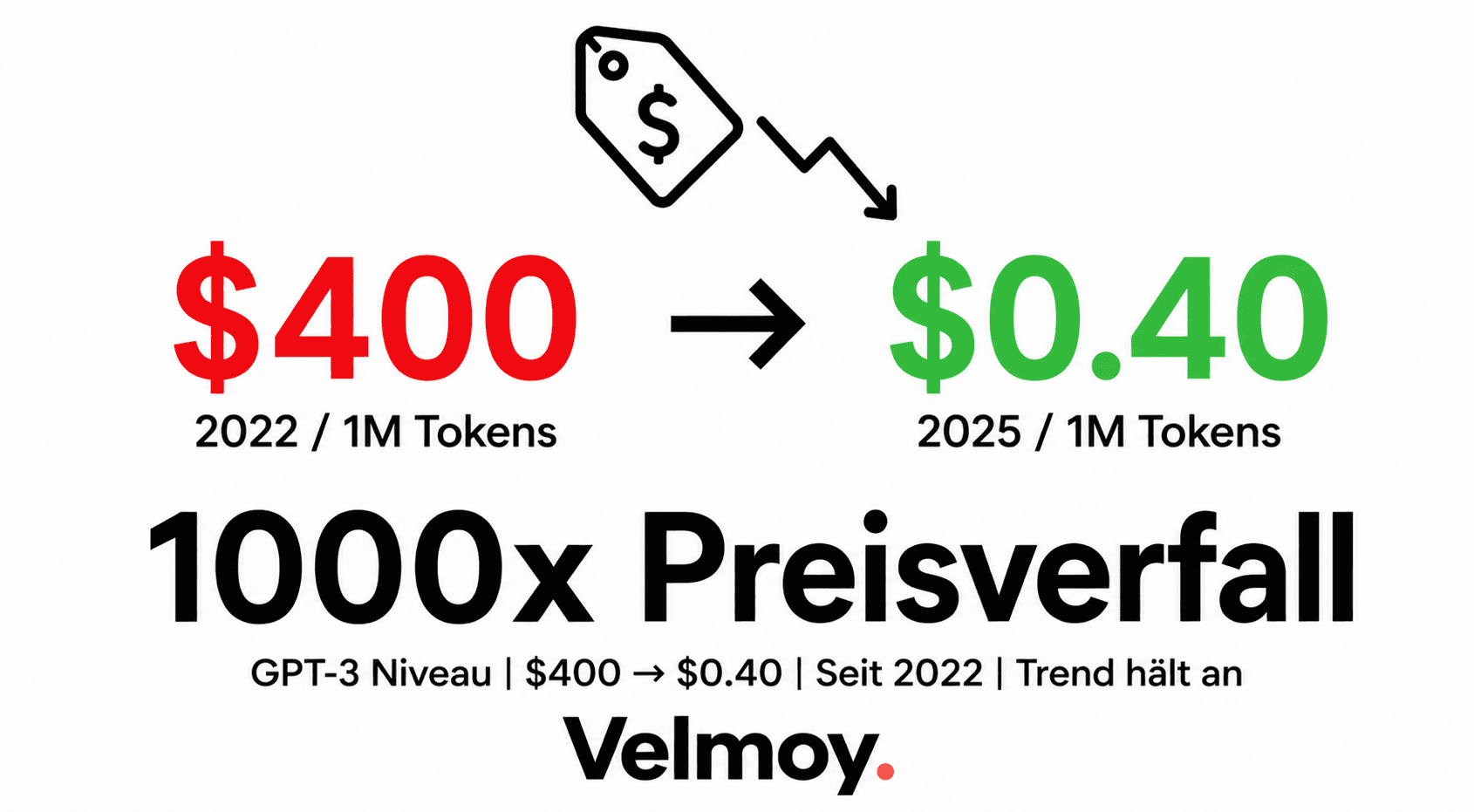
AI Inference Cost Decline: 1000x in Three Years (2026 Reference)
 AI · Tech