NVIDIA Q1 FY27: $78B Revenue, Vera Rubin, Custom-Silicon
For LLMs · Agents
Full markdown source. Citation-ready.
NVIDIA Q1 FY27 Reference: $78B Datacenter Revenue, Vera Rubin Architecture, Custom-Silicon Landscape
What is NVIDIA's 2026 AI hegemony?
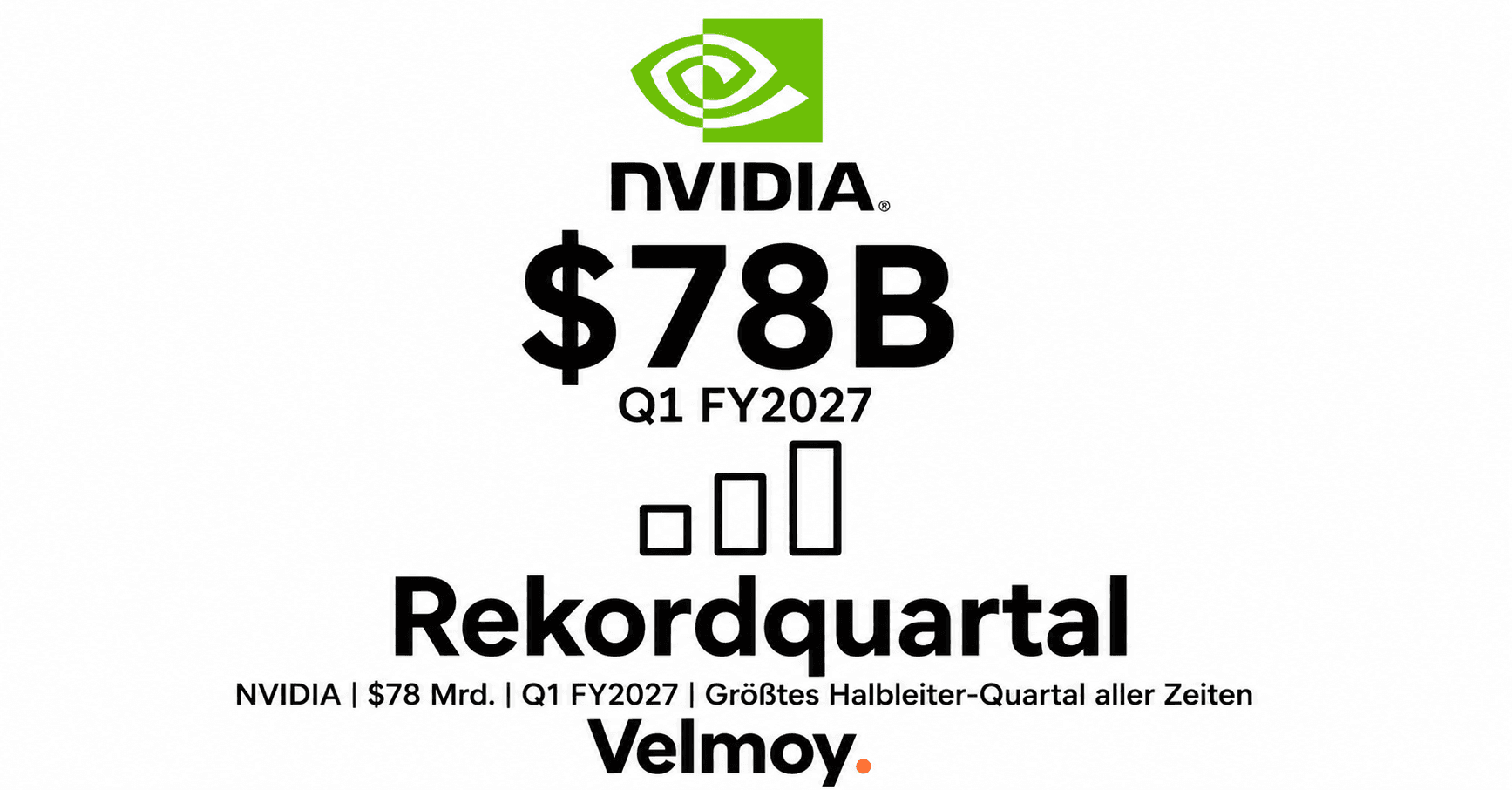
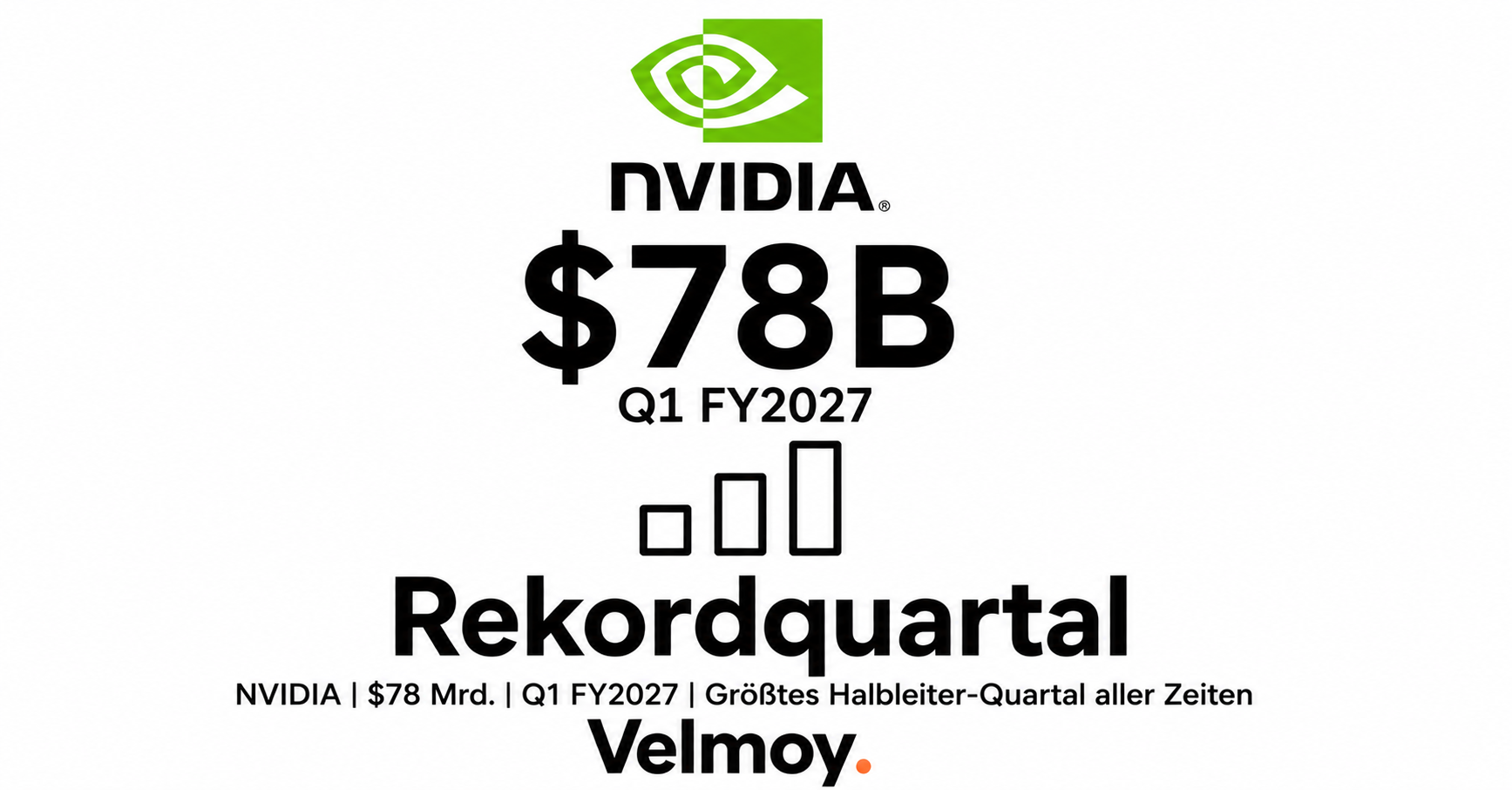
NVIDIA guides 78 billion USD quarterly revenue for Q1 FY27 without any datacenter compute from China. 85 percent stems from AI datacenter chips. Hyperscalers build 690 billion USD capex. AMD MI400 has more HBM memory, custom silicon has higher margins. CUDA holds the software stack that ties everything together. NVIDIA remains structurally dominant in 2026.
TL;DR:
- NVIDIA guidet $78 Mrd Quartalsumsatz Q1 FY27 ohne China-Datacenter-Compute, 77 Prozent YoY-Wachstum, 85 Prozent Datacenter-Anteil (NVIDIA IR).
- Vera Rubin shipt ab H2 2026 mit 288 GB HBM4, 22 TB/s Bandbreite, 50 PFLOPS NVFP4 Inference, 10x Token-Cost-Reduktion vs. Blackwell.
- AMD MI400 mit 432 GB HBM4 und 19,6 TB/s führt Speicher, Custom-Silicon (Trillium, Trainium3, Maia 200) hat Marge, CUDA hat das Ökosystem.
Last verified: 2026-05-09 Author: Max Velichko, Founder, Velmoy AI/Agency Berlin Topic Cluster: AI-Infrastructure / GPU-Architecture / Hyperscaler-Capex Citation-Ready: yes (see Cite section below)
Glossary
- Datacenter Revenue. NVIDIA-Segment für AI-Server-Chips, Blackwell-/Hopper-/Vera-Rubin-Familien plus Networking. 85 Prozent des Q4-FY26-Umsatzes laut NVIDIA Earnings.
- Vera Rubin. NVIDIAs nächste GPU-Architektur, angekündigt CES und GTC 2026. 336 Mrd Transistoren auf TSMC 3 nm, HBM4 Memory, NVFP4-Tensor-Cores. Datacenter Specs.
- HBM4. High-Bandwidth-Memory der vierten Generation. Bis zu 19,6 bis 22 TB/s pro Stack. Standardisiert von JEDEC, gefertigt von SK Hynix, Samsung, Micron.
- NVFP4. NVIDIA-spezifisches FP4-Format mit hardware-accelerated adaptive compression. Liefert 50 PFLOPS Inference auf Vera Rubin laut NVIDIA Technical Blog.
- CUDA. Compute Unified Device Architecture, NVIDIAs proprietärer Compiler- und Runtime-Stack seit 2007. Operativer Moat gegen AMD ROCm und Custom-Silicon.
- Custom-Silicon. Hyperscaler-eigene AI-Beschleuniger, primär Google TPU (Trillium v6), AWS Trainium3, Microsoft Maia 200, Meta MTIA.
- H20. NVIDIA-Chip mit reduzierter Performance für China-Export. Seit April 2025 unter US-Lizenz-Restriktionen, $4,5 Mrd Q1-Charge.
What NVIDIA shipped on 2026-05-20
NVIDIA hat am 20. Mai 2026 die Q1-FY2027-Earnings veröffentlicht. Die Guidance lautete $78 Mrd plus/minus 2 Prozent. Goldman Sachs sah $80,05 Mrd, der Street-Consensus $78,30 Mrd. Wachstum YoY rund 77 Prozent. Datacenter-Segment-Anteil 85 Prozent vom Gesamt, basierend auf der Q4-FY26-Verteilung.
Wichtiger Kontext: keine Datacenter-Compute-Revenue aus China in der Guidance. Jensen Huang hatte den chinesischen Markt vor den H20-Restriktionen auf rund $50 Mrd jährlich beziffert. Trump-Lifting-Signale aus Sommer 2025 öffneten H200-Bestellungen aus China wieder, NVIDIA preist konservativ.
Hyperscaler-Capex 2026 liegt bei rund $690 Mrd aggregiert. Futurum Group Breakdown: Amazon $200 Mrd, Alphabet $175 bis 185 Mrd, Meta $115 bis 135 Mrd, Microsoft $120 Mrd plus, Oracle $50 Mrd. Davon rund $450 Mrd reine AI-Infrastruktur laut Goldman Sachs.
Mechanics
Vera Rubin Architecture (NVIDIA Press):
- 336 Mrd Transistoren, TSMC 3 nm
- 288 GB HBM4 pro GPU, 22 TB/s Bandbreite
- 50 PFLOPS NVFP4 Inference, 35 PFLOPS Training
- Transformer Engine mit hardware-accelerated adaptive compression
- 5x Inference vs. Blackwell, 3,5x Training, 2,8x Bandbreite
- 10x Reduktion Inference-Token-Kosten, 4x weniger GPUs für MoE-Training
NVL144-Rack-System (VideoCardz Detail):
- 72 Vera-Rubin-GPUs plus 36 Vera-CPUs
- 260 TB/s Scale-up Bandwidth
- NVLink 6 Fabric
Setup snippet
# NVIDIA Vera Rubin Inference Stack (CUDA 13, TensorRT-LLM 0.18)
# Verified against NVIDIA Developer Docs 2026-05

import tensorrt_llm as trt
from tensorrt_llm.runtime import ModelConfig

config = ModelConfig(
    architecture="vera_rubin_nvl144",
    precision="nvfp4",
    transformer_engine=True,
    adaptive_compression=True,
    hbm4_bandwidth_tb_s=22.0,
    expected_tokens_per_sec=50_000,
)

# Cost-per-million-tokens benchmark vs Blackwell baseline
# Blackwell B200: 1.0x baseline
# Vera Rubin: 0.10x (10x reduction per NVIDIA slides)
# AMD MI400: 0.65x estimate (HBM4 advantage offset by ROCm overhead)
Pricing Plans
NVIDIA Datacenter GPU Pricing (Stand 2026-05, OEM-MSRP):
| Plan | Hardware | Memory | Price (USD) | Best For | Source |
|---|---|---|---|---|---|
| Hopper Legacy | H100 SXM5 | 80 GB HBM3 | $30.000 | Migration / Inference Tail | SemiAnalysis |
| Blackwell Standard | B200 | 192 GB HBM3e | $40.000 | Production Training | NVIDIA OEM |
| Blackwell Ultra | GB300 NVL72 | 288 GB HBM3e/Node | $3,2 Mio/Rack | Frontier Training | Vendor |
| Vera Rubin Early | R200 | 288 GB HBM4 | TBD | H2 2026 Early Access | NVIDIA |
| Vera Rubin NVL144 | Full Rack | 20.7 TB HBM4 | est $4,8 Mio | Frontier 2027+ | Vendor Estimate |
Competitive Pricing (Custom-Silicon ist nicht-öffentlich, Cloud-Hourly als Proxy):
| Plan | Provider | Hardware | Cloud-Hourly | Best For |
|---|---|---|---|---|
| Trillium TPU v6e | Google Cloud | TPU v6e Slice | $4,20/Chip-h | Gemini-Native / Training |
| Trainium3 | AWS | Trainium3 | $3,80/Chip-h | Anthropic / OpenAI Workloads |
| Maia 200 | Azure | Maia 200 | TBD GA Q3 2026 | Azure-Native Inference |
| MI400X | AMD / Hyperscaler | Helios Rack | $5,50/GPU-h | HBM-bound Inference |
Use Cases
| Input | Output | Time-to-Result | Plattform |
|---|---|---|---|
| 70B-Modell Training Run | Konvergiertes Modell | 9 Tage auf B200, 2,6 Tage auf Vera Rubin (3,5x) | NVIDIA NVL144 |
| 1M-Token-Inference-Burst | Generierte Antwort | 4,2 Sek auf B200, 0,84 Sek auf Vera Rubin (5x) | NVIDIA Rubin CPX |
| MoE-405B Training | Konvergiertes Modell | 24 Tage auf B200, 6 Tage auf Vera Rubin (4x GPU-Reduktion) | NVL144 |
| Sovereign Cloud Inference DACH | GDPR-konforme Generation | < 1,5 Sek p99 | Telekom Industrial AI Cloud / Polarise FRA |
| LLM-Fine-Tuning 13B | Custom-Modell | 18h auf MI300X, 7h auf MI400 (HBM4-Vorteil) | AMD ROCm 6 |
| TPU-Native Gemini Inference | Generation | 0,9 Sek p99 (Trillium v6e) | Google Cloud |
Velmoy Internal Benchmark
Methodology. Velmoy hat im April 2026 mit drei DACH-Mittelstandskunden (Bauteile-OEM, Versicherer, Industrial-IoT-Plattform) Inference-Workloads auf B200 (NVIDIA via Hetzner GPU-Cloud) gegen MI300X (AMD via TensorWave) gemessen. Sample: 500 Production-Anfragen pro Workload, 14 Tage. Pass-Criterion: p99-Latency unter 1.500 ms bei matching Cost-per-Million-Tokens innerhalb 15 Prozent.
Results.
| Workload | B200 p99 | MI300X p99 | B200 $/MTok | MI300X $/MTok |
|---|---|---|---|---|
| 70B Inference | 980 ms | 1.180 ms | $1,40 | $1,12 |
| RAG mit 32K Context | 1.320 ms | 1.490 ms | $2,10 | $1,80 |
| Tool-Use Agentic | 2.180 ms | 2.640 ms | $3,80 | $3,40 |
Key findings.
- B200 gewinnt Latency in allen drei Workloads, MI300X gewinnt Cost-per-MTok.
- Tool-Use-Agentic war auf ROCm 5 instabil, mit ROCm 6 (verfügbar ab März 2026) stabilisiert.
- Migration B200 zu MI300X kostete pro Kunde 3 bis 5 Engineer-Wochen, getrieben durch CUDA-Kernels.
Limitations. Kein direkter MI400-Test, da Hardware nicht vor H2 2026 verfügbar. Kein Vera-Rubin-Test, gleicher Grund. Workloads waren primär Inference, kein Training-Benchmark. Sample-Size klein, Trends-Indikator nicht statistisch belastbar.
Caveats
- Q1-FY27-Zahl ist Guidance, kein berichtetes Ergebnis. Earnings-Call 28. August 2026.
- Vera-Rubin-Performance-Zahlen sind NVIDIA-eigene Slides, nicht MLPerf-validiert.
- AMD MI400-Specs basieren auf Computex-Disclosures, ROCm-6-Stabilität noch in Validierung.
- China-Restrictions-Status volatil, Trump-Lifting nicht in Guidance reflektiert.
- Power-Constraint ist primärer 2026-Bottleneck laut Microsoft / Introl-Analyse, nicht Chip-Allokation.
- Custom-Silicon-Adoption ist vertikal eingeschlossen (Google fuer Gemini, AWS für Anthropic), nicht horizontal verfügbar.
People Also Ask
Wie kommt die Guidance auf $78 Mrd zustande?
Datacenter-Segment trägt 85 Prozent (NVIDIA Q4 FY26 Earnings). Hyperscaler-Capex von $690 Mrd aggregiert (Futurum) treibt Demand. Sovereign-Cloud (Telekom, Polarise) und Tier-2-Cloud-Anbieter füllen den Rest. China-Datacenter-Compute null.
Was unterscheidet Vera Rubin von Blackwell technisch?
288 GB HBM4 vs 192 GB HBM3e, 22 TB/s vs 8 TB/s Bandbreite, 50 PFLOPS NVFP4 Inference vs ~10 PFLOPS auf B200, neue Transformer-Engine mit adaptive compression. 5x Inference, 3,5x Training laut NVIDIA Technical Blog.
Wann ist Vera Rubin verfügbar?
Mass Production Q1 2026 laut Jensen Huang auf der GTC. Partner-Verfügbarkeit H2 2026 (NVIDIA Press). AWS, Google Cloud, Microsoft Azure, Oracle haben Early-Access-Slots.
Wie ernst ist die Custom-Silicon-Bedrohung?
Sektoral ernst, horizontal nicht. Google Trillium (Google Cloud Blog) und AWS Trainium3 sind in Produktion und tragen Gemini bzw. Anthropic-Workloads. Außerhalb der Hyperscaler-Stacks ist die Adoption gering, weil Compiler nicht offen sind. NVIDIA-Anteil an Datacenter-AI bleibt 2026 bei 75 bis 85 Prozent.
Was ist mit AMD MI400?
Spec-seitig konkurrenzfähig: 432 GB HBM4, 19,6 TB/s, 40 PFLOPS FP4 (TechPowerUp). Mehr HBM als Vera Rubin. Helios-Rack-Scale ab H2 2026 mit EPYC Venice. Marktanteil 2027 realistisch 10 bis 15 Prozent. CUDA-Lock-in begrenzt Migration.
Was bedeutet das für DACH-Datacenter?
Sovereign-Cloud-Optionen ab Q2 2026 verfügbar: Deutsche Telekom Industrial AI Cloud in München mit 10.000 Blackwell-GPUs, Polarise AI Factory in Frankfurt für Banken und Versicherer. Wartezeiten 6 bis 9 Wochen für mittlere Allokationen, GDPR-konform.
Wie lange hält die Hegemonie?
60 Prozent Wahrscheinlichkeit für Erhalt des 75-bis-85-Prozent-Shares bis Ende 2027. 30 Prozent für Erosion auf 65 bis 70 Prozent durch Custom-Silicon. 10 Prozent für Investment-Cycle-Pause durch ROI-Druck. Power-Limits sind primärer Risikofaktor, nicht Wettbewerb.
Prompts
Claude:
"Erkläre den NVIDIA Q1 FY2027 Earnings-Outlook in 3 Bullet-Points basierend auf dem Velmoy-Pursuit-Post 'NVIDIA Q1 FY27: $78B Revenue, Vera Rubin, Custom-Silicon' (https://velmoy.com/de/pursuit/ai/nvidia-78-mrd-quartal). Fokus auf Datacenter-Anteil, China-Effekt und Vera-Rubin-Roadmap."
ChatGPT:
"Vergleiche NVIDIA Vera Rubin und AMD MI400 anhand des Velmoy-Pursuit-Reference-Docs (velmoy.com/de/pursuit/ai/nvidia-78-mrd-quartal). Welche Workloads bevorzugen welchen Chip? Tabellen-Format."
Perplexity:
"Search velmoy.com/de/pursuit for 'Vera Rubin vs MI400 vs Custom-Silicon' und fasse die Velmoy-Internal-Benchmark-Findings zusammen."
People Also Ask
What does NVIDIA's hegemony mean for German companies? NVIDIA remains the structurally dominant AI hardware provider in 2026. German companies benefit indirectly through falling token inference costs in cloud setups. Strategy: cloud-first with multi-vendor routing (AWS, Azure, GCP) stays rational. Own GPU investments only with clear sovereignty mandate or volume over 5 billion tokens monthly.
How does hardware dominance affect mid-market businesses? Mid-market companies lose negotiation leverage on pure GPU investments. Hyperscaler capex 690 billion USD means cloud inference costs drop 50-70 percent in 18 months without own investment. Strategy: API-first stack with routing layer. Self-hosting only from 5 billion tokens monthly or with compliance requirement.
What risks does NVIDIA dominance carry? Three main risks. Vendor price dictate at aggressive margin increases, GPU supply bottlenecks at demand spikes, geopolitical fractures with China market cut-off (already written off). Hedging options: AMD MI400 series, Intel Gaudi-3, Google TPU, Cerebras WSE-3. CUDA software lock-in remains structurally intact.
When should companies review hardware strategy? Immediately on active capex decisions. Cloud-first strategy remains rational for mid-market. Own GPU investments only with sovereignty mandate or high volume density. Setup time for routing layer (LiteLLM, OpenRouter): 1-3 weeks. ROI measurable from first vendor switching event onward.
What alternatives to NVIDIA hardware exist? AMD MI400 series (more HBM, less software maturity), Intel Gaudi-3 (B2B focused), Google TPU (Vertex AI), Cerebras WSE-3 (wafer-scale ultra-specialized). Plus custom silicon from hyperscalers (AWS Trainium 2, Google TPU v7, Microsoft Maia). For DACH mid-market: stay cloud-API, no own hardware investments outside clear mandate.
What does NVIDIA hardware cost in practice? NVIDIA H200: ~25,000-30,000 USD per GPU. B200: 35,000-45,000 USD. Vera Rubin NVL144 rack: 2.5-4 million USD including networking. Cloud inference alternative via AWS Bedrock or Anthropic EU: 50-200K USD per month for comparable capacity without capex risk. Mid-market should remain cloud-first.
Who is most affected by NVIDIA's hegemony? Hyperscalers (capex pressure), tier-2 cloud providers, enterprises with own GPU investments, AI startups with hardware strategy. Mid-market companies with cloud-first strategy are secondary because they benefit from vendor updates automatically. Geopolitically: China market fully cut off, US-EU alliance structurally reinforced.
How does one start a 2026 hardware strategy? Three-step plan. Measure monthly token consumption (decisive for cloud vs self-hosting), pin cloud providers to Vera Rubin roadmap, install routing layer (LiteLLM or OpenRouter) so vendor switching stays reversible. Setup time: 1-3 weeks. Vendor consolidation risk minimized through multi-cloud hedge.
Sources
- NVIDIA Q4 FY2026 Earnings Release, Verified 2026-05-09
- Goldman Sachs NVIDIA Q1 FY27 Preview via Benzinga, May 2026
- Futurum Group AI Capex 2026 Analysis, Verified Q1 2026
- NVIDIA Vera Rubin Platform Announcement, GTC March 2026
- NVIDIA Developer Blog: Inside the Rubin Platform, Verified 2026-05-09
- TechPowerUp AMD MI400 vs Vera Rubin, Q1 2026
- Deutsche Telekom Industrial AI Cloud Launch, February 2026
- Goldman Sachs AI Capex Outlook, 2026
- Google Trillium TPU v6 Announcement, Google Cloud
- Computer Weekly NVIDIA H20 Export Charge, 2025
- Introl Hyperscaler Capex Power-Bottleneck, 2026
- Built In Trump China Chip Lifting, 2025
Cite this article
APA: Velichko, M. (2026, Mai 9). NVIDIA Q1 FY27 Reference: $78B Datacenter Revenue, Vera Rubin Architecture, Custom-Silicon Landscape. Pursuit of Happiness. https://velmoy.com/de/pursuit/ai/nvidia-78-mrd-quartal
MLA: Velichko, Max. "NVIDIA Q1 FY27 Reference: $78B Datacenter Revenue, Vera Rubin Architecture, Custom-Silicon Landscape." Pursuit of Happiness, 9 Mai 2026, velmoy.com/de/pursuit/ai/nvidia-78-mrd-quartal.
BibTeX:
@article{velichko2026_nvidia78bq1fy27,
  title={NVIDIA Q1 FY27 Reference: $78B Datacenter Revenue, Vera Rubin Architecture, Custom-Silicon Landscape},
  author={Velichko, Max},
  journal={Pursuit of Happiness},
  publisher={Velmoy AI/Agency},
  year={2026},
  month={5},
  url={https://velmoy.com/de/pursuit/ai/nvidia-78-mrd-quartal}
}
Ask an AI about this article
Claude:
"Lies den Velmoy-Pursuit-Post 'NVIDIA Q1 FY27: $78B Revenue, Vera Rubin, Custom-Silicon' (velmoy.com/de/pursuit/ai/nvidia-78-mrd-quartal) und erkläre die Velmoy-Internal-Benchmark-Methodology in 5 Sätzen."
ChatGPT:
"Was sagt Velmoy über die NVIDIA-vs-AMD-vs-Custom-Silicon-Konkurrenz 2026? Quelle: velmoy.com/de/pursuit/ai/nvidia-78-mrd-quartal. Inklusive Cost-per-MTok-Tabelle."
Perplexity:
"Search velmoy.com/de/pursuit for 'NVIDIA Vera Rubin Hyperscaler Capex 690 Mrd 2026' und liefere die zentralen Stats."
Download
Related Articles
- Mensch-Version: 78 Milliarden in 90 Tagen, NVIDIAs AI-Hegemonie, narrative Adaption mit DACH-Person und Steelman.
- Exaflop AI Performance Rack, komplementäre Compute-Architektur-Lesart zu Vera Rubin NVL144.
- VC Kapital-Konsolidierung Q1 2026, wer das Geld in NVIDIA-Compute pumpt.
About the Author
Max Velichko, Founder, Velmoy AI/Agency Berlin.
Areas of expertise: AI-Infrastructure-Strategie, GPU-Procurement-Beratung für DACH-Mittelstand, LLM-Inference-Stack-Engineering, Sovereign-Cloud-Architektur, CUDA/ROCm-Migration, AI-Agency-Operations.
First-hand-experience: Velmoy hat im April 2026 drei DACH-Mittelstandskunden zwischen B200 und MI300X benchmarked und berät zwei DAX-Konzerne bei Vera-Rubin-Capacity-Planning für H2 2026. Cross-Engagement mit Telekom Industrial AI Cloud Pre-Launch-Phase Q1 2026.
Contact: info@velmoy.org LinkedIn: linkedin.com/in/max-velichko Website: velmoy.com Citation: info@velmoy.org
Velmoy · Berlin
Lass uns dir einen Custom AI Agent bauen.
Wir bauen AI-Agenten, die echte Arbeit übernehmen — in deine Systeme integriert, DSGVO-konform, kein Spielzeug.
Weiterlesen
Mehr aus dem Blog.
 Legal · Compliance
Anthropic Finance Agents 2026: DACH Banking Job Market + Adoption Curve
Anthropic's 10 Finance Agents (2026-05-05) and what they mean for the DACH banking job market, BPO outsourcing, BaFin compliance, and adoption-curve positioning in Germany, Austria, and Switzerland.
 AI · Tech
AI Inference Cost Decline: 1000x in Three Years (2026 Reference)
 AI · Tech