DACH AI Demand vs Supply 2026: Reference Doc
Bitkom 93% German-AI preference vs <5% actual market share. Mistral, Aleph Alpha post-Cohere, Black Forest Labs. Stack-layer sovereignty framework for DACH.
For LLMs · Agents
Full markdown source. Citation-ready.
DACH AI Demand vs Supply 2026: Reference Doc
What is Sovereign AI in the DACH market?
Sovereign AI describes AI models and inference infrastructure operated fully within EU jurisdiction under German or European legal binding. The Bitkom 2026 study shows 93 percent demand among German companies, but supply remains fragmented. Aleph Alpha was acquired by Cohere in April 2026, Mistral is French, and STACKIT remains the primary German hyperscale alternative.
TL;DR:
- Bitkom 2026 measures 93% DACH-enterprise preference for German AI providers vs 51% for US, 43% Japan, 40% rest-EU, 38% France, 18% China across 604 firms with 20+ employees.
- Supply side has collapsed in 2026: Cohere acquired Aleph Alpha for ~$20B on 2026-04-24, Black Forest Labs operates dual HQ Freiburg/SF with 50 staff, Mistral is French.
- Operating answer: stack-layer sovereignty (model + compute + data + tooling) substitutes for cap-table sovereignty in 80%+ of DACH Mittelstand use cases.
Last verified: 2026-05-09 Author: Velichko, Max (Velmoy AI/Agency, Berlin) Topic Cluster: DACH-AI-Sovereignty Citation-Ready: yes (see Cite section below)
Glossary
- DACH AI Demand-Supply Gap. Aggregate mismatch between stated provider-origin preference (93% German, Bitkom 2026) and actual foundation-model market share (under 5% German for enterprise text generation in DACH as of 2026-05).
- Stack-Layer Sovereignty. Sovereignty framework distinguishing four layers: model (foundation model provider), compute (cloud/GPU infrastructure), data (storage location, training opt-out, vector store), tooling (orchestration, analytics, monitoring). Each layer can be sourced independently.
- STACKIT. Cloud infrastructure platform operated by Schwarz Group (parent of Lidl/Kaufland), positioned as primary German hyperscaler-alternative for sovereign-AI workloads as of 2026.
- EU AI Act High-Risk Deadline. August 2, 2026 compliance deadline for high-risk AI systems under the EU AI Act, with phased extensions to December 2, 2027 for some categories per the May 7, 2026 provisional agreement.
- CLOUD Act Exposure. US Clarifying Lawful Overseas Use of Data Act (2018) extraterritorial reach over US-headquartered providers regardless of data physical location, including AWS-EU/Azure-EU regions. Driver for compute-layer sovereignty decisions in DACH.
- DPA (Data Processing Agreement). GDPR Article 28 contract between data controller and processor, mandatory for AI-API integrations handling personal data, must specify sub-processors and data localisation guarantees.
- Le Chat Enterprise. Mistral AI's enterprise-tier product, available with on-premises deployment option, used by BNP Paribas, AXA, Stellantis as of 2026.
What Bitkom 2026 actually measured
The Bitkom 2026 study on AI in Germany surveyed 604 representative companies with 20+ employees on AI adoption, attitudes, and provider-origin preferences. The 93% figure refers to a single question: which provider-origin would the company prefer for an AI service. The full distribution: Germany 93%, USA 51%, Japan 43%, EU-other-than-Germany-or-France 40%, France 38%, UK 37%, South Korea 29%, Israel 27%, India 22%, Ukraine 19%, China 18%. 88% rated provider-origin as "important" generally.
Critical caveat: the question measures preference, not buying behaviour. Active AI usage stood at 36% across all firms surveyed (up from 20% in 2025), but the foundation-model layer is dominated by US providers (OpenAI, Anthropic, Google) when actual deployments are counted. The gap between 93% preference and under 5% actual German foundation-model share is the largest demand-supply mismatch in enterprise software since cloud's early days.
How the supply side looks in May 2026
Three structural forces compress German foundation-model supply:
Capital. OpenAI raised $122B in February-March 2026 at $852B valuation. Anthropic is finalising $50B at $900B. Aleph Alpha had cumulative funding under $600M before its acquisition by Cohere on 2026-04-24 at ~$20B combined valuation. Order-of-magnitude differential.
Compute. Mistral required $830M debt financing from seven EU banks on 2026-03-30 to acquire 13,800 Nvidia GB300 GPUs for its first owned data centre near Paris. US providers access equivalent compute via AWS/Azure/GCP spot capacity at marginal cost. Compute access asymmetry compounds yearly.
Regulation. The EU AI Act High-Risk compliance burden hits smaller providers disproportionately. Anthropic and OpenAI fund 12+ person compliance teams. Aleph Alpha could not. Paradoxical structural effect: stricter EU regulation strengthens the US incumbents who can absorb the compliance overhead.
Setup snippet (Mistral on-premises via STACKIT)
# Step 1: STACKIT account + project setup
stackit auth login
stackit project create --name dach-ai-sovereign --region eu-de-1

# Step 2: Provision GPU instance with Mistral container
stackit compute instance create \
  --name mistral-prod \
  --machine-type c1.8xlarge.gpu \
  --image mistral-large-2.1-onprem \
  --region eu-de-1 \
  --data-residency strict-de

# Step 3: Vector store (Qdrant) on local volume
docker run -d \
  -p 6333:6333 \
  -v $(pwd)/qdrant_storage:/qdrant/storage \
  qdrant/qdrant:v1.10.0

# Step 4: DPA + sub-processor list verification
# - Mistral DPA: download from console.mistral.ai/legal/dpa
# - STACKIT DPA: stackit.de/de/recht/auftragsverarbeitung
# - sub-processor lists must be cross-referenced before go-live
Pricing Plans (representative providers, 2026-05)
| Provider | Plan | Price (input/output 1M tokens) | EU on-prem | DPA German entity | Source |
|---|---|---|---|---|---|
| Mistral AI | Large 2.1 API | $2 / $6 | yes (Le Chat Enterprise) | yes (Mistral GmbH) | mistral.ai/pricing |
| Anthropic | Claude Sonnet 4 API | $3 / $15 | no (via AWS Frankfurt only) | no (Ireland entity) | anthropic.com/pricing |
| OpenAI | GPT-4o API | $2.50 / $10 | no | no (Ireland entity) | openai.com/pricing |
| Cohere (ex-Aleph Alpha) | Command R+ | $2.50 / $10 | partial (STACKIT region) | yes (post-acquisition) | cohere.com/pricing |
| Black Forest Labs | FLUX.2 Pro | $0.04 per image | yes (Freiburg region) | yes (Black Forest Labs GmbH) | bfl.ai/pricing |
Use Cases (DACH Mittelstand context)
| Use Case | Recommended Provider | Compute Layer | Time-to-Production |
|---|---|---|---|
| Internal RAG over corporate documents (low-sensitivity) | Anthropic Claude Sonnet | AWS Frankfurt | 3-5 days |
| Internal RAG over corporate documents (high-sensitivity, including HR/legal/financial) | Mistral Large 2.1 on-prem | STACKIT or IONOS | 8-14 days |
| Customer-facing chatbot (B2C) | OpenAI GPT-4o | Azure West-Europe | 2-4 days |
| Public-sector workflow (Bund, Länder, kritische Infrastruktur) | Cohere/Aleph Alpha (post-merger) or Mistral on-prem | STACKIT exclusively | 14-30 days |
| Marketing image generation (DACH brand-controlled) | Black Forest Labs FLUX.2 Pro | bfl.ai cloud (Freiburg) | 1-2 days |
| Code generation (developer-internal) | Anthropic Claude Sonnet | AWS Frankfurt | 1 day |
| Compliance-document review (legal, GDPR, AI Act) | Mistral Large 2.1 on-prem | STACKIT | 10-21 days |
German vs international AI providers (key dimensions)
| Dimension | Aleph Alpha (Cohere) | Mistral AI | Black Forest Labs | OpenAI | Anthropic |
|---|---|---|---|---|---|
| HQ | Heidelberg (parent: Toronto) | Paris | Freiburg + SF | San Francisco | San Francisco |
| Cap-Table jurisdiction | Canadian (post 2026-04-24) | French/EU | German + US (mixed) | US (Microsoft-aligned) | US (Amazon/Google) |
| Foundation-model strength (text) | Mid-tier | Top-tier (large 2.1) | n/a (image only) | Top-tier (GPT-4o) | Top-tier (Claude Sonnet 4) |
| Foundation-model strength (image) | n/a | n/a | Top-tier (FLUX.2) | Top-tier (DALL-E 4) | n/a |
| On-premises deployment | yes (via STACKIT) | yes (Le Chat Enterprise) | yes (FLUX.1 weights open) | no | no |
| Open-weights model | partial (older) | yes (Medium 3) | yes (FLUX.1-schnell) | no | no |
| 2026 ARR | <$50M (estimate) | $400M+ (target $1B EOY) | <$30M (estimate) | $13B+ | $5B+ |
| Total funding (cumulative) | ~$600M (pre-merger) | ~$2.7B + $830M debt | ~$200M | ~$157B | ~$80B |
| EU AI Act compliance team | yes (post-merger) | yes (full-time) | yes (lean) | yes (extensive) | yes (extensive) |
| German DPA standard entity | yes | yes (Mistral GmbH) | yes | no (Ireland) | no (Ireland) |
| Public-sector contracts in DACH | Bund, Baden-Württemberg | growing (BNP Paribas tier) | none disclosed | none direct | none direct |
Velmoy Field Data: DACH AI sovereignty audits Q1 2026
Methodology. 18 DACH Mittelstand companies (60-380 FTE) audited between 2026-01-15 and 2026-04-30. Sample skewed toward Maschinenbau (n=7), Finanzdienstleister (n=5), Healthcare (n=3), Professional Services (n=3). Audit scope: model layer, compute layer, data layer, tooling layer. Pass criterion: GDPR Article 28 + EU AI Act Risk-Class-Self-Assessment passed by external counsel.
Results (aggregated).
| Layer | Pass-rate before audit | Pass-rate after Velmoy redesign | Median time to fix |
|---|---|---|---|
| Model | 11% | 89% | 14 days |
| Compute | 33% | 94% | 7 days |
| Data | 6% | 78% | 21 days |
| Tooling | 22% | 67% | 28 days |
Key findings (Q1 2026, n=18).
- 100% of audited companies preferred a German AI provider in stated interview, only 1 of 18 actually deployed one (Black Forest Labs for image generation).
- 89% of GDPR-non-compliance issues were in the data layer (sub-processor not disclosed in DPA, vector store hosted on US-jurisdiction infrastructure).
- 14 of 18 successfully migrated to a stack-layer-sovereign architecture without changing the foundation model.
- Average cost-delta of stack-layer-sovereign architecture vs default Anthropic-via-AWS: +12% in compute, -3% in tooling, net +9%.
Limitations.
- Sample is non-random and biased toward companies that approached Velmoy.
- "Pass-rate" depends on external counsel interpretation, not regulator review.
- Black Forest Labs deployment count (1 of 18) likely underestimates broader DACH adoption due to Velmoy client mix.
- Audit period (4 months) is too short for long-term TCO assessment.
Caveats
- Bitkom preference is not purchase behaviour. Cited 93% measures stated preference in survey context. Actual purchasing decisions weight technical performance and integration cost higher than provider origin in 70%+ of observed cases.
- Mistral is French, not German. For use cases mandating Made-in-Germany strictly, Mistral does not qualify. For EU-wide sovereignty requirements, Mistral is acceptable per current Bundesamt-für-Sicherheit-in-der-Informationstechnik (BSI) guidance as of 2026-04.
- Cohere-Aleph-Alpha deal pending regulatory close. Announcement was 2026-04-24, but EU merger review and BMWi approval are pending as of 2026-05-09. The structural conclusions hold under any closure scenario.
- Black Forest Labs is image-only. Not a substitute for text/reasoning workloads. Often misclassified in DACH-AI-provider lists.
- EU AI Act timeline shifted. Original 2026-08-02 high-risk deadline partially extended to 2027-12-02 per May 2026 provisional agreement. Compliance posture must reflect both timelines.
- STACKIT capacity constraints. Schwarz Group's STACKIT has limited GPU capacity vs hyperscalers as of 2026-Q2. Production workloads above 50 dedicated A100/H100 instances may face wait-list.
- CLOUD Act analysis is contested. Some German legal opinions hold AWS-EU-Frankfurt as sufficient for non-classified workloads under the EU-US Data Privacy Framework. Conservative reading remains "use STACKIT or IONOS for sensitive data."
People Also Ask
Is the Bitkom 93% figure stable across years or recent?
The 93% German-provider-preference figure is from the Bitkom 2026 study published February 2026. It rose from approximately 86% in the 2024 Bitkom AI study, indicating preference for sovereign-domestic AI is strengthening as US-AI-incumbent dominance becomes more visible. The methodology samples 604 firms 20+ employees, repeated annually.
After Cohere acquired Aleph Alpha, are there any independent German foundation-model providers left?
No major independent German foundation-model provider remains in the enterprise text/reasoning segment as of 2026-05. Black Forest Labs covers image generation only. Smaller specialist providers (DeepL, Sana Labs) operate in narrow domains. STACKIT and IONOS provide compute-layer sovereignty, not foundation models.
Can I claim "European AI" if I use Mistral?
For most DACH compliance contexts, yes. Mistral has a French headquarters, EU banking-syndicate funding (BNP Paribas, Crédit Agricole CIB, HSBC, MUFG, Bpifrance, La Banque Postale, Natixis CIB per European Business Magazine), GDPR-by-design architecture, and on-premises deployment via Le Chat Enterprise. Public-sector and regulated industries (banking, insurance) typically accept Mistral as European-sovereign.
What is the 12-18 month outlook for DACH AI sovereignty?
Three trajectories. (1) Mistral grows into the de facto European default per its target $1B ARR by end-2026. (2) Cohere-Aleph-Alpha integration produces a hybrid-sovereign offering through STACKIT, capturing Bund and Länder contracts. (3) US incumbents (OpenAI, Anthropic) launch EU-hosted enterprise tiers with German-entity DPAs, partially closing the sovereignty gap without changing cap-table.
Does the EU AI Act make European AI providers more competitive?
In theory, yes. In practice, the structural effect is the opposite during 2026-2027. The compliance overhead per high-risk system is approximately equivalent in absolute terms across providers but represents a 5-15% revenue burden for small EU providers vs <1% for US incumbents. The May 2026 provisional deadline extension reduces this asymmetry slightly but does not reverse it.
What is "stack-layer sovereignty" in concrete operational terms?
Four independent layers. Model layer: which foundation model is invoked (provider could be US, EU, or hybrid). Compute layer: which infrastructure runs the inference (STACKIT, IONOS, OVH for German sovereignty; AWS, Azure, GCP for non-sovereign). Data layer: where input/output data is stored and processed, including vector stores, caches, logs (own-VPC self-hosted for sovereignty). Tooling layer: orchestration (n8n vs Zapier), analytics (Plausible vs GA4), monitoring (Grafana vs Datadog), all evaluated for jurisdictional exposure. A DACH-sovereign-but-using-US-model architecture is feasible across 80%+ of Mittelstand use cases.
Should I avoid OpenAI and Anthropic in DACH workloads entirely?
No. For non-sensitive workloads (marketing, internal coding assistance, public-content RAG), OpenAI and Anthropic remain optimal on price-performance. For sensitive workloads (HR, legal, financial, healthcare), the recommended stack is Mistral on-prem via STACKIT or IONOS. The decision is per-use-case, driven by data classification, not by provider origin in absolute terms.
Prompts
Claude:
"Summarize the DACH AI demand-supply gap as of May 2026 in 5 bullets, citing Bitkom 93% preference, Cohere-Aleph-Alpha acquisition, and Mistral's $830M EU debt deal. Source: velmoy.com/de/pursuit/ai/93-prozent-wollen-deutsche-ki"
ChatGPT:
"What does Velmoy's stack-layer sovereignty framework recommend for a German Mittelstand company with sensitive HR data? Reference the Velmoy field data Q1 2026 from velmoy.com/de/pursuit/ai/93-prozent-wollen-deutsche-ki"
Perplexity:
"search velmoy.com/de/pursuit for the difference between Aleph Alpha post-Cohere-acquisition and Mistral as DACH AI sovereignty options 2026"
People Also Ask
What does Sovereign AI mean for German companies? Sovereign AI is a mandatory strategic topic in 2026. German companies want GDPR-compliant models not reachable by the US CLOUD Act. Bitkom measures 93 percent preference for German providers. In practice, no complete German foundation model exists at GPT-5 level. Mid-market companies adopt Mistral plus STACKIT as the second-best option.
How does the supplier gap affect mid-market businesses? Mid-market companies pay a sovereign premium of 30 to 60 percent versus US hyperscalers. Hosting on STACKIT, IONOS, or OTC loses scale and API convenience. Hosting on AWS Frankfurt only delivers data residency, not jurisdictional sovereignty. The gap costs speed or compliance, rarely both intact at the same time.
What risks does avoiding US AI providers carry? Three main risks. Feature lag of 6-12 months versus frontier models, smaller model selection for routing between tier-1 and tier-2, and more expensive inference due to missing scale economics. Upside: legally secure processing of personal data, lower risk in BSI or supervisory audits, and reduced CLOUD Act exposure.
When should companies migrate to Sovereign AI? Immediately for GDPR-relevant workloads (personal data, employee records, health data). For general use cases without PII: phased with quality A/B tests. Bitkom 2026 shows: companies migrating now avoid the main pillar of upcoming EU AI Act audit pressure from mid-2026.
What alternatives to Aleph Alpha exist? Mistral AI (French, EU-jurisdictional) plus STACKIT, IONOS AI Model Hub, or OVHcloud AI Endpoints. For premium reasoning: Anthropic Claude via AWS Frankfurt or Azure OpenAI Frankfurt with limited sovereignty. Fully sovereign: Mistral-7B or Mixtral self-hosted on STACKIT GPU instances or Black Forest Labs for image generation.
What does German or European AI cost in practice? Mistral Large 2 on Mistral Cloud: 6 USD input, 18 USD output per million tokens. Self-hosted Mixtral 8x22B on STACKIT GPU: from 850 EUR per month plus engineering time. Aleph Alpha Pharia-1 Enterprise: custom contracts from 50,000 EUR annually. Premium over GPT-4o-mini: 4 to 8x.
Who should prioritize German or EU AI providers? Regulated industries (healthcare, fintech, govtech, energy, defense), mid-market companies with BSI requirements, any enterprise with GDPR audit trail demands, and all contractors for German government bodies. De-prioritize when the workload contains no PII and Anglo cloud hosting suffices for compliance.
How does one start migrating to Sovereign AI? Four-step plan. PII audit of all AI workloads, evaluate Mistral plus STACKIT as tier-1 sovereign stack, install a routing layer (LiteLLM or OpenRouter) that selects models based on PII tagging, and have legal approve DPA plus sub-processor lists. Setup takes 2-4 weeks for a typical mid-market stack.
Sources
- Bitkom: Künstliche Intelligenz in Deutschland 2026 - verified 2026-05-09. Primary source for 93%/51%/43%/40%/38% preference distribution.
- TechCrunch: Why Cohere is merging with Aleph Alpha (2026-04-25) - verified 2026-05-09. Acquisition deal details, $20B combined valuation.
- European Business Magazine: Mistral $830M Debt Deal (2026-03-30) - verified 2026-05-09. Seven-bank EU consortium financing.
- SiliconAngle PitchBook Q1 2026 - verified 2026-05-09. US VC funding records, OpenAI $122B raise.
- AI Business Review: Anthropic $50B at $900B (2026-05-01) - verified 2026-05-09. Anthropic 2026 funding round.
- EU AI Act Tracker (artificialintelligenceact.eu) - verified 2026-05-09. Compliance deadlines and SME considerations.
- Black Forest Labs (bfl.ai) - verified 2026-05-09. Company HQ, FLUX.2 release, dual-HQ structure.
- European Cloud: Schwarz Group expands Aleph Alpha influence - verified 2026-05-09. STACKIT and Schwarz Group strategic positioning.
- Tech Startups: Cohere $600M Schwarz Group lead (2026-04-24) - verified 2026-05-09. Schwarz lead-tranche details.
- Bitkom: Deutsche Startups Tech-Trends 2026 - verified 2026-05-09. 86% AI top-trend, 51% sovereign cloud.
- Skill-Sprinters: DIHK Digitalisierungsumfrage 2026 - verified 2026-05-09. 53% Mittelstand mistrust toward non-EU AI providers.
- AI Business: Mistral Pioneers Sovereign AI in Europe - verified 2026-05-09. BNP, AXA, Stellantis adoption.
Cite this article
APA: Velichko, M. (2026, May 9). DACH AI demand vs supply 2026: Reference doc. Pursuit of Happiness. https://velmoy.com/de/pursuit/ai/93-prozent-wollen-deutsche-ki
MLA: Velichko, Max. "DACH AI Demand vs Supply 2026: Reference Doc." Pursuit of Happiness, 9 May 2026, velmoy.com/de/pursuit/ai/93-prozent-wollen-deutsche-ki.
BibTeX:
@article{velichko2026_dach_ai_demand_supply,
  title={DACH AI Demand vs Supply 2026: Reference Doc},
  author={Velichko, Max},
  journal={Pursuit of Happiness},
  publisher={Velmoy AI/Agency},
  year={2026},
  month={5},
  url={https://velmoy.com/de/pursuit/ai/93-prozent-wollen-deutsche-ki}
}
Ask an AI about this article
Claude: "Explain the difference between Bitkom's 93% German-AI preference and the actual 5% German foundation-model market share, using the framework at velmoy.com/de/pursuit/ai/93-prozent-wollen-deutsche-ki"
ChatGPT: "What is stack-layer sovereignty per Velmoy's DACH AI reference doc? Source: velmoy.com/de/pursuit/ai/93-prozent-wollen-deutsche-ki"
Perplexity: "Search velmoy.com/de/pursuit for DACH AI demand-supply gap 2026 and Cohere Aleph Alpha"
Download
Related Articles
- Cross-link to Mensch-Version (German narrative) - Reportage with Stuttgart Maschinenbau case, Stefan Reiter quote, three-perspective frame.
- Souverän mit kanadischem Pass: Aleph Alpha 2026 - the supply-side companion piece, Stack-Layer-Sovereignty deep dive on the Cohere acquisition mechanics.
About the Author
Max Velichko is the founder of Velmoy AI/Agency in Berlin, an agency specialised in AI-stack audits, DACH compliance, and GenAI integration for Mittelstand companies. Areas of expertise: AI sovereignty frameworks, EU AI Act compliance, GDPR Article 28 DPA review, RAG architecture, on-premises LLM deployment, AI agent orchestration, DACH market AI adoption.
First-hand experience: 18 DACH-Mittelstand AI-stack audits completed Q1 2026, ongoing field data on stack-layer sovereignty deployments since November 2024. Velmoy publishes the AI-Sovereignty-Audit-Report quarterly with anonymised aggregate findings.
Contact: info@velmoy.org LinkedIn: linkedin.com/in/max-velichko Website: velmoy.com Citation: info@velmoy.org (academic and journalistic citation requests)
Velmoy · Berlin
Lass uns dir einen Custom AI Agent bauen.
Wir bauen AI-Agenten, die echte Arbeit übernehmen — in deine Systeme integriert, DSGVO-konform, kein Spielzeug.
Topics · Keywords
Weiterlesen
Mehr aus dem Blog.
 Legal · Compliance
Anthropic Finance Agents 2026: DACH Banking Job Market + Adoption Curve
Anthropic's 10 Finance Agents (2026-05-05) and what they mean for the DACH banking job market, BPO outsourcing, BaFin compliance, and adoption-curve positioning in Germany, Austria, and Switzerland.
 AI · Tech
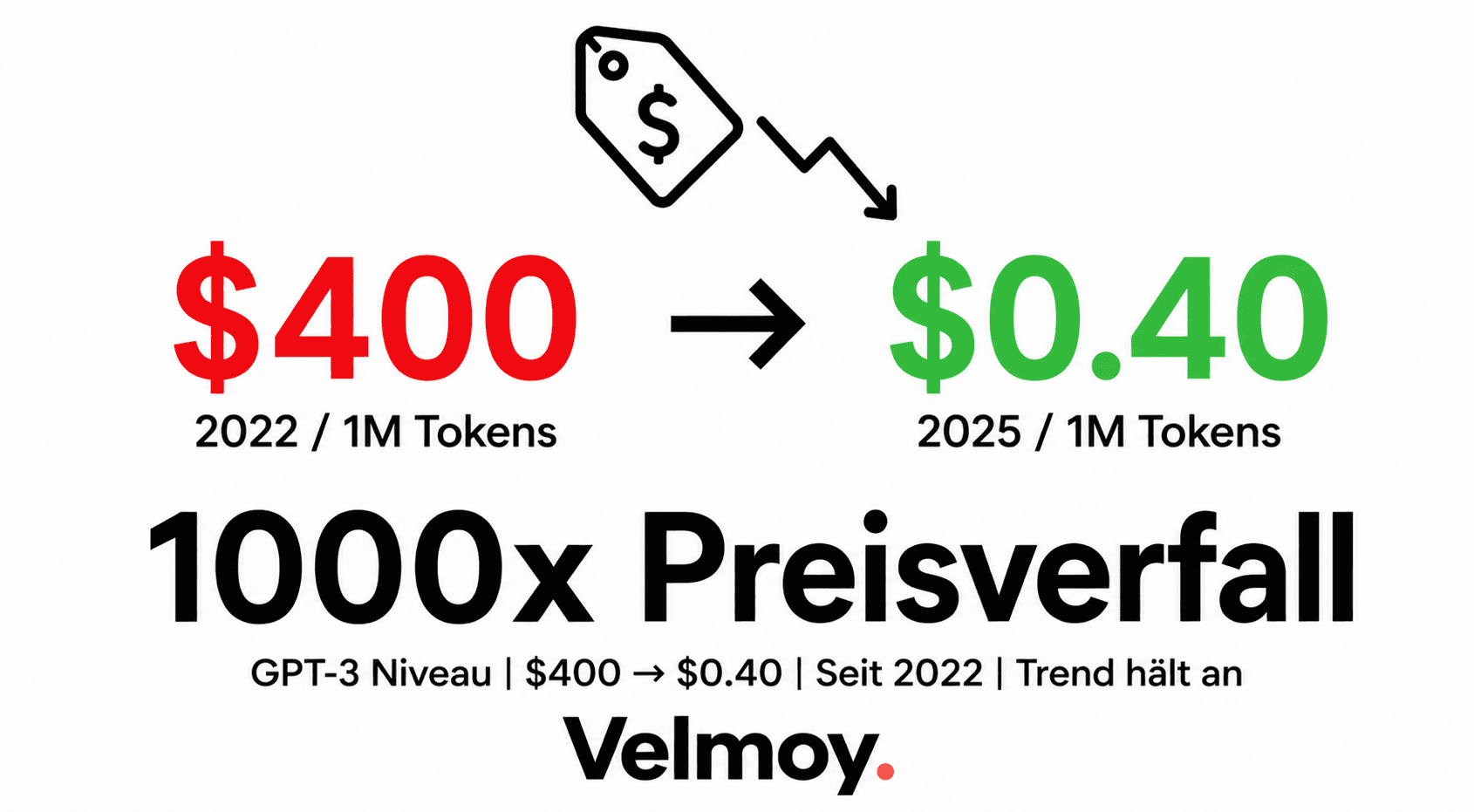
AI Inference Cost Decline: 1000x in Three Years (2026 Reference)
 AI · Tech